
Three. BIG. Things. 1/11
If you missed it, we got it. An art, tech, whatever newsletter.


But First, a Quick Note:
Welcome to 2026, and our first newsletter of the year! I like to keep things fresh around here, so I’ll be changing our newsletter format going forward. Something I noticed over the past year was how pigeonholed I sometimes felt by its weekly need to discuss crypto art and tech and cryptocurrency. Only so much you can play around with that form. Realistically, however, sometimes interesting stuff happens in only one place, not in another. I think we all prefer to chase fascination instead of format, so I’m calling the 2026 newsletter Three. BIG. Things., and each week, we’ll cover three stories of note from the various spheres surrounding crypto art. That could be art itself, digital art and contemporary, it could be AI or the metaverse or 3D printing, it could be financial, entertainment, whatever. It’s a better brush, a larger canvas, and more colors of paint, in keeping with our theme.
And most importantly, I want to say thanks for sticking around with me week after week into another year. I really do treasure our time together, this little rectangle in which you and I get to catch-up, and I hope we’ll be able to do it for a long time yet.
This Week’s Three BIG Things:
NFT Paris is Dead
If Grok is Snatching our Bodies, then What is Left?
Cryptocurrency: Nemesis to International Law
Here we Go:
1. NFT Paris and RWA Paris Close Shop
Announced this week on their main Twitter page, stalwart NFT and crypto art conference, NFT Paris, has apparently gathered for the final time. This year’s edition, intended to open next month at Paris’ Grand Halle de la Villette, will not happen, though the reasons given are vague. Vague, sure, but don’t we know the story already?
The announcement —dual-posted to NFTParis’ Twitter page and founder, Alexandre Tsydenkov’s, LinkedIn— says, “The market collapse hit us hard. Despite drastic cost cuts and months of trying to make it work, we couldn't pull it off this year.” In tone, it’s essentially the same message used to detail the end of Async.Art and Makersplace in the last few years, though more explicit about market conditions. Of the last two remaining large-scale NFT conferences —NFT NYC and NFCSummit in Lisbon— I have insight only on the latter, thanks to a conversation last year with its founder John Karp. Even he, and about a different topic altogether, conceded the difficulty in gathering sufficient sponsorship to cover conference costs. It’s harder and harder to operate a sustainable business in the crypto/NFT/web3 ecosystem regardless of intent, vertical, or audience. Everything is dwindling. As businesses struggle, their marketing budgets shrink, their sponsorship dollars recede, they lay-off staff, and the downstream effects of their incapacity are felt in the culture. It’s impossible to make a business work if the money isn’t there. It’s impossible to make a conference work if you’re not selling tickets. We forget sometimes, when so many people decry the gumptionless many who flee the NFT ecosystem whenever the market turns sour, that each body lost is a possible impression, attendee, investor, or customer. Companies rely on those, even ambiently.
NFTParis did not go quietly. They were still announcing speakers on December 30th, just over a week-and-a-half ago. I don’t know what happened in the interim, but I imagine bills came due that nobody could pay. In the aftermath of their announcement, some harangued the organization for pandering last year to new ecosystems they saw as active enough to capitalize on. Spinning-off a sister conference, RWA Paris, specifically concerning the tokenization of real-world assets, for example. As usual, plenty were eager to dance on NFTParis’ grave, citing poor displays, shady economics, and the general premise of centralized NFT conferences.
But I am not going to dance on NFTParis’ grave. I never went, nor was I overly familiar with them beyond the name. Given how few places have ever inspired the wider NFT ecosystem’s gathering in one place, is it really prudent to regurgitate all their faults? I’m sure NFTParis had its problems, but this is really about where our niche crypto art culture —and the larger categories it fits within— is going. Away from the big. Away from the expensive. The things we’re seeing succeed today are small, they’re nimble, and even in cases like Art Blocks Marfa Weekend or Zero 10 — the “digital art” conglomerate at Art Basel Miami this year, put together by Eli Schienman— it’s mostly grassroots. Yes, grassroots, even if it does not appear so at first glance.
Some context: my first NFTNYC was in 2021. My second and third were in 2022 and 2023. I did not go the past two years, but I was in and around an Avalanche conference in Buenos Aires at the tail-end of 2024, for what that’s worth. A single refrain underpinned all of those conferences, and judging by some of the comments regarding NFTParis, it penetrates the others as well. We know that nobody within crypto art —at best a tiny minority and often for shits, giggles, or because they were invited to speak— actually attended the NFTNYC conference when it came to Manhattan. Artists, collectors, developers, and critics came to New York for the conference, but the conference itself was simply an impetus. Really, it was SuperRare and Superchief and Lume Studios and DADA and the many other people/businesses/groups holding smaller, satellite events which inspired our crowd to attendance. I was “at NFTNYC,” but really I was just in New York with all these crypto artists, bopping from gallery to gallery, meal to meal, event to event, exhausted and half-drunk and fresh out of cab fare. The thing itself was never the draw. The environment around the thing provided the energy.
For this same reason, I invoked Zero 10 a few paragraphs ago. Grassroots does not mean punk rock, it means self-started and self-sustained. Sure, many burnt-out, perfectly logical, righteously indignant artists would look to the Art Basel board and Eli Scheinman and Node Foundation and that entire crowd as centralized entities par excellence. I am not denying that. But the reason Zero 10’s works and artists actually made a dialectic dent in our carbonited movement is the manifold host of people who were in and around the conference. Yes, the small dinners. Yes, the parties. Yes, the stoned coffee table conversations. It’s not that it’s not exclusive, it’s not that it’s not inaccessible, but it still proves that success in crypto art and NFTs is about getting people all in one place. Eli Scheinman, Benny Redbeard, Micky Malka, they may be well-connected and well-off, but their individual —even aligned— actions are succeeding where massive entities with years of centralized support and corporate backing have failed.
One very ambitious, very well-connected person is worth an entire scrambling staff —even a very talented one— when it comes to impacts in this movement. Might we internalize that into the conference paradigm? Might we not name a place, decide a time, contact the galleries, the platforms, the artists, and get the people all together? It’s as deviously simple as it is nearly impossible. Get people to gather. Reach a critical mass, and watch dominos begin to fall. The central impediment to getting this done is, to my eye, a lack of connection between the remaining entities within crypto art. Why is there not more alignment? Why are there not communications happening in real time? It should be clear by now that individuality is a zero-sum game. An art movement is more than the sum of its parts. The businesses left standing must all be put in communication; they need do nothing more than announce a smattering of events all around the same weekend. The Redbeards and Eli’s and Nodes and Cryptopunk influencers of this movement, if they knew what was good for them, would be working to create frenzy, and frenzy comes from enthusiasm. We know enthusiasm comes from conglomeration. My point is, we shouldn’t be waiting for Art Basel. Or NFT NYC. There needs not be some huge, complicated, centralized apparatus requiring oodles of capital. We do not need to rent out some grand convention center in Paris, we need only entice the people to Paris. Creativity will spawn. At NFT NYC the last year I went, Lume Studios held exhibitions. Makingit24/7 hosted their own gallery of works in Brooklyn. Here is where people with reach should be putting their efforts. Many talk about how the best part of their experiences at conferences are the haphazard get togethers, the unplanned run-ins, the unexpected late-nights in an apartment or the back of a bar. I concur!
Let us rid ourselves of the song and dance of centralization. Let us spill out into small, sporadic spaces all across a municipality. Let us leave behind large halls, calendars of events, and expensive tickets. The institutions which have survived until now are small, and they do everything themselves. Let us take a note from them and conduct our gatherings in the same way.
Someone hit me up, and let’s get something going.
2. The Problem of Grok, Unauthorized Nudity, and Consent
As usual, my thoughts go back to high school. The comments was common, coming from every adult in my orbit. The consequences to ignoring their advice were terrifying: colleges would deny my application, it would be impossible to find a job, I’d become a persona non grata. This was during peak social media integration into our lives but before Facebook’s Cambridge Analytica scandal when privacy controls, for instance, were much in use or even available. And we had all heard the horror stories.
Some girl, say, with intimidating grades and excellent extracurriculars, a really competitive resumé, denied a spot at her dream college because some snooping supervisor had found their way onto her Facebook. There, the supposedly bright, supposedly future-minded, supposedly responsible young woman could be seen with red solo cups in-hand, the subject of bleary pictures of bloodshot eyes taken from very close-up, and my goodness, in how many posts did she use the F-word? Upload photos of herself in a bikini? Sprinkle suggestive comments all over her friends’ timelines? Certainly not collegiate material, not collegiate material at all.
I never knew anyone personally to whom it happened, but horror stories abounded. This always felt gross and nonconsensual, that unknown parties were going to make snap judgments about a person based on a Facebook (then, Facebook was still king) cultural ecosystem they in all likelihood could not understand. When I voiced that concern to those older and around me, I was met, quite unexpectedly, with agreement. Agreement in principle, but the reality was —or so I was told— if it was on the internet, it could be used against me. As Rooney Mara says in The Social Network (2010), “The internet's not written in pencil, Mark, it's written in ink.” So be careful what you post.
We knew not what awaited us but a decade later.
I probably don’t have to explain what’s happening with Grok AI, the Elon-Musk-pushed chatbot now integrated into Twitter. I imagine you’re aware. While some people use Grok to add innocent context on individual posts (“Grok, explain Venezuelan oil reserves to me” someone might have written under an image of captured dictator, Nicolás Maduro), too many, and too quickly, realized that its image-generation and manipulation tools lack any common sense safeguards.
In the words of Nick Robins-Early, writing for the Guardian:
“Many users on X have prompted Grok to generate sexualized, nonconsensual AI-altered versions of images in recent days, in some cases removing people’s clothing without their consent…’There are isolated cases where users prompted for and received AI images depicting minors in minimal clothing,’ Grok said in a post on X in response to a user. ‘xAI has safeguards, but improvements are ongoing to block such requests entirely.’”
The story itself only gets weirder, according to AV Club’s Drew Gillis, who writes “This morning, Grok has been responding to users asking for photo edits (whether sexual in nature or not) with ‘Image generation and editing are currently limited to paying subscribers,’” as if verified users are more responsible than their unverified peers. Perhaps the thinking is that, if they’re paying, their credit card information is connected, also personal details about them, and so any criminal activity could be traceable back to a source. However, even this seems to be a lie. Robert Hart at The Verge reported that, “No, Grok hasn’t paywalled its deepfake image feature. X’s sexual deepfake machine is still running, despite Grok saying otherwise.” That’s not even a quote from the article, actually. It’s just the title.
TechCrunch has a good write-up on the political ramifications of Grok’s fucked-up activity, including British Prime Minister, Keir Starmer' threatening to ban the platform in the UK entirely.
For the rest of us without political power, the very existence of our likeness online is now a threat. Sure, I don’t think any of us are going to be denied college applications. Does that even still happen? But we can all be placed on a whim into scantily-clad outfits or sexually-explicit positions. Humiliation are now completely out of our control. This is not revenge porn; we never took even a small step towards the untoward. But some schmuck on Twitter has decided remove our agency and our clothes alike, and we are literally powerless to intervene.
Imagine the warnings given to college-age children today. Their images merely being online is dangerous, every face another weapon in an armory, its contents freely-accessible to anyone who stumbles upon them, regardless of intentions. I can only imagine the helplessness, the embarrassment, the terrifying nature of seeing ourselves out there on the internet in a form we would never consent to, exposed as we would never expose ourselves.
It’s like Elon Musk and Twitter want to convince the world away from social media. Because complete anonymity, which could only be gained by abstinence, is the only possible antidote to this activity, right? What does it feel like to lose control of one’s likeness? Nobody is rushing to put pictures of me in a thong (please keep it that way), so I do not yet know what it’s like to see a picture of me except it’s not me. It’s one thing to distrust what we see on the internet by rule, but it’s another to see ourselves distorted and misrepresented, objectified, denigrated, not even because of something inflammatory we did or said, not because we have lechers hanging onto our thirst trap beach selfies, but because there are tools integrated into our everyday digital lives by which those with sordid imagination can change us. Imagine this tool weaponized. Imagine the shame.
Forget legal. Forget even emotional. Philosophically, what do we own in the world that cannot be taken away from us? Property, cash, assets: of course not. Our health is out of our control, but our bodies are ours. To pamper, to masturbate, to destroy, to treat as we see fit, belonging entirely to us. Our bodies and thoughts alone are ours to do with as we please. The denigration of those things physically, assault and battery and manipulation, are traumatic events we would not wish upon even our enemies. Here, however, is a conceptual assault, a removal of agency over the contents and confines of our body by din of simply existing in a digital sphere. And the worst part: you know where this goes. First, we are undressed. And then? And then…
Nor does it take much to argue that between echo chambering, rage baiting, or algorithmic manipulation and bias, agency over our minds has already been long stolen.
Digital existence, originally if you remember, was additive. We gained connections with those faraway or long unspoken to. We gained insight into the lives of others. What we could share, send, discuss, bond over, this was the point. Through message boards and forums and social media apps, the internet gave to us. But so quickly, digital existence has begun reducing us down. Using ChatGPT for research takes away our drive. Our knowledge and insight. These models were trained on data we provided, stripping us of ownership. Coming for our bodies, however, is a new and drastic removal, a corrupt incursion into a last-remaining sacred space. How much do we have to fucking lose before we step back from this thing? How much does it have to take from us? My cousin, a very long-time heroin addict, has lost everything to that substance. Her appearance, her brain, her sense, and after a recent stroke, her ability to even speak, perhaps even function on her own. That’s how a drug works: it takes slowly, then quicker and quicker, more and more greedily, until we are consumed. Yes, it is cliché at this point to compare social media to drug use. But it’s only becoming more and more apt. The entire digital ecosystem is disruptive and destructive, disappointing, dysregulating.
As soon as we step into the digital country of 2026, our agency is removed entirely. Introduce a name, that name can be warped, given false voice, made to speak. As soon as we post a picture, we can be turned into pornography. How could we have known, in posting ice bucket challenge videos on Facebook fifteen years ago, we would be volunteering for such carnage?
What more can even be taken?
3. Cryptocurrency is Destabilizing International Affairs
It’s one of those stories that you hear for the first time and just makes complete sense. Oh, yeah, duh, of course that would be the case. We already know that a completely cut-off nation-state like North Korea can circumnavigate poor currency conditions using cryptocurrency, which is why they have become so competent at hacks, drains, and theft. Not like the North Korean government cares much for international law to begin with.
But international law is one of those funny things which sounds really high-minded and universal, but which is really a tall beach-house built upon rotting stilts. Who determines international law? Who enforces it? Based on collective buy-in, its existence predicates upon agreement and existing power struggles. If you’ve been made the target of international sanctions designed by a large and influential and wealthy bloc of nations intended to destroy your economy, your goal is not necessarily to join the consensus, it’s to get the fuck out from under the yoke of your peers as quickly as possible.
Crypto, once again, is the cure to what ails you (if you are a nation-state and what ails you is international economic sanctions).
Quietly, the international media has seemed to discover that cryptocurrency is in high demand by countries seeking to avoid economic punishment. To quickly understand how economic works, let’s look at the Venezuela situation with the help (sue me) of ChatGPT:
“International sanctions in the context of Venezuela are a set of targeted economic and legal restrictions (like asset freezes, trade embargoes, and travel bans) imposed on Maduro, his allies, and key Venezuelan state entities—especially the oil sector—to choke off revenue and pressure the regime. These sanctions work by blocking access to global financial systems, freezing assets under jurisdiction, banning normal commercial dealings (e.g., in oil revenues or shipping), and prohibiting firms and individuals from engaging with designated persons or companies, thereby reducing the regime’s cash flow and diplomatic legitimacy.”
The physical limitations —the embargoes, blockades, and travel bans— are not important here. Look instead to countries like Russia, as explained by Melissa Lawford at YahooNews, which a few years ago invented its own Stablecoin, A7A5, to conduct business with foreign banks after their standard currency, the Ruble, was sanctioned. Banks could not interact with the Ruble without risking retaliation from the U.S. and its allies. However, “The US tightened the criteria [for sanctions] last summer. It has become far more difficult for Russian companies to buy or sell goods across the border. Crypto offers a workaround because the transactions occur on largely unregulated exchanges.”
As per Andrew Folkler at Crypto.News, “Stablecoins accounted for 84% of all illicit transaction volume in 2025, according to Chainalysis. The firm attributed their prevalence to price stability, ease of cross-border transfer, and widespread liquidity, noting that the same features driving legitimate adoption have also attracted sanctioned users.”
How exactly does crypto allow for sanction evasion? Melissa Lawford quotes Andrew Fierman, Head of National Security Intelligence at ChainAnalysis, who mentions how “a sanctioned drone manufacturer that was supplying Russia… received all of its payments from a single cryptocurrency address that had made trades worth a combined $40m.” Untraceable, untrackable, easily-laundered, the money disappears from view.
This is a shockingly widespread practice. Lawford mentions that “Global use of cryptocurrencies by rogue states such as Russia, Iran and North Korea surged by 694% last year to around $100bn. Sanctions evasion has become by far the largest category of overall crypto crime…with a record $154bn in transactions to illicit addresses.” The story has already been picked up by the Washington Post, Fortune, and other mainstream publications.
Omar Faridi at CrowdFundInsider discusses another kind of illicit crypto scheme, in which “Chinese money laundering networks (CMLNs) emerged as dominant players, providing “laundering-as-a-service” for fraud, North Korean hacks, and even terrorist financing.”
This is a realm it’s hard to give much thought to (at least I find it hard) without a solid background in macroeconomics. All the reasons we simple folk love cryptocurrency —its anonymity, self-sovereignty, decentralization— are equally compelling for massive actors with geopolitical implications. An app like TornadoCash, for example, isn’t threatening to the U.S. Government because some bank robbers can launder money inside, for example. Fraudsters, hackers, whoever, they’re all small potatoes. It’s because geopolitical hegemony requires control, and when money can be turned into slush and sent around to international enemies without surveillance, it destabilizes that hegemony. Agree or disagree, that’s how it works, it’s the impetus for action. One weakness in a suit of armor is all it takes if one’s aim is true. If Russia is able to take their Ruble, turn it into a stablecoin, and send that stablecoin out to some central-Asian drone manufacturer who can subsequently turn that stablecoin into Bitcoin and sell it for USD on an exchange somewhere without any prying eyes seeing what they’ve done, it circumnavigates the intended purpose of sanctioning both parties. Not that geopolitical economic maneuvering or subterfuge is anything new, not that weapons manufacturers haven’t been shady since weapons manufacturers first existed (basically, this is the plot of every James Bond movie), but crypto is a tool for this activity that cannot be uniformly regulated, especially when huge exchanges exist all over the world, across spheres of influence, when existing cryptocurrencies number in the many-millions, when the ground-level development continues outpacing governmental oversight.
DeCC0 of the Week
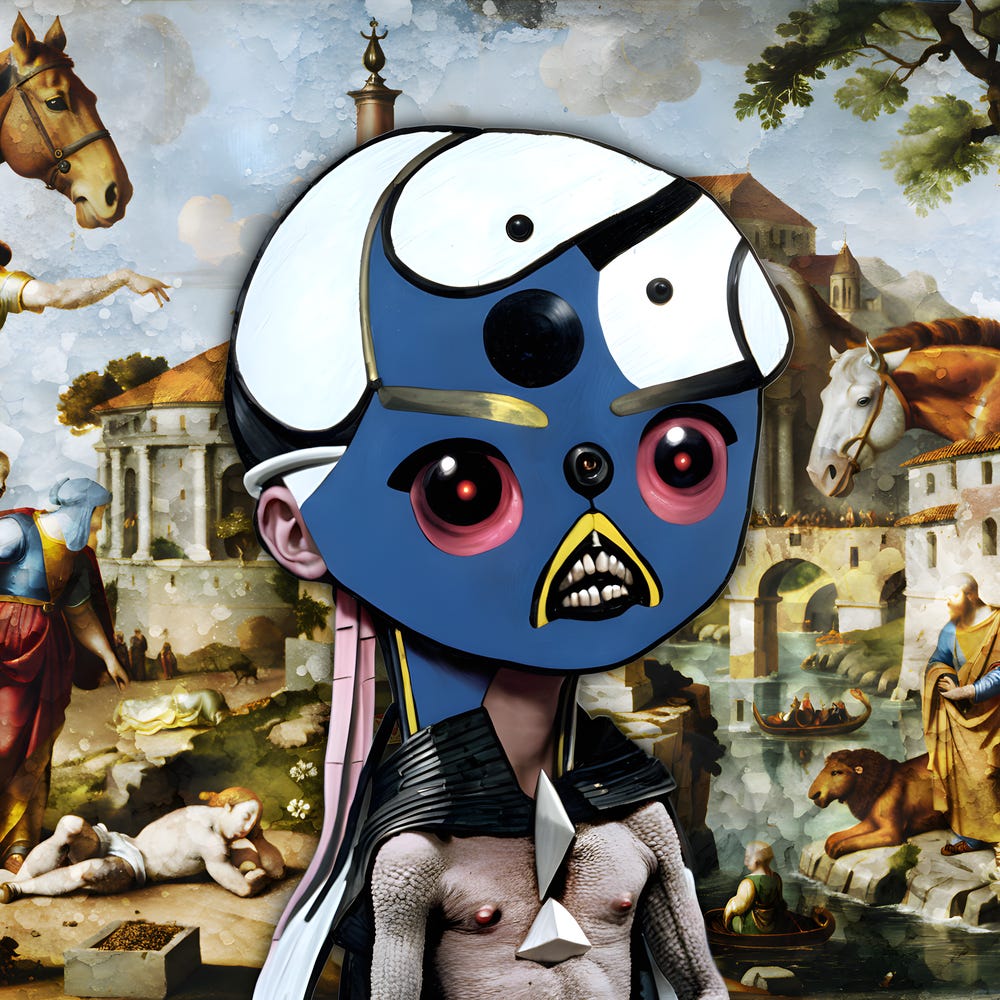
Introducing, Art DeCC0 #8021, Uumama:
Art in the Wild
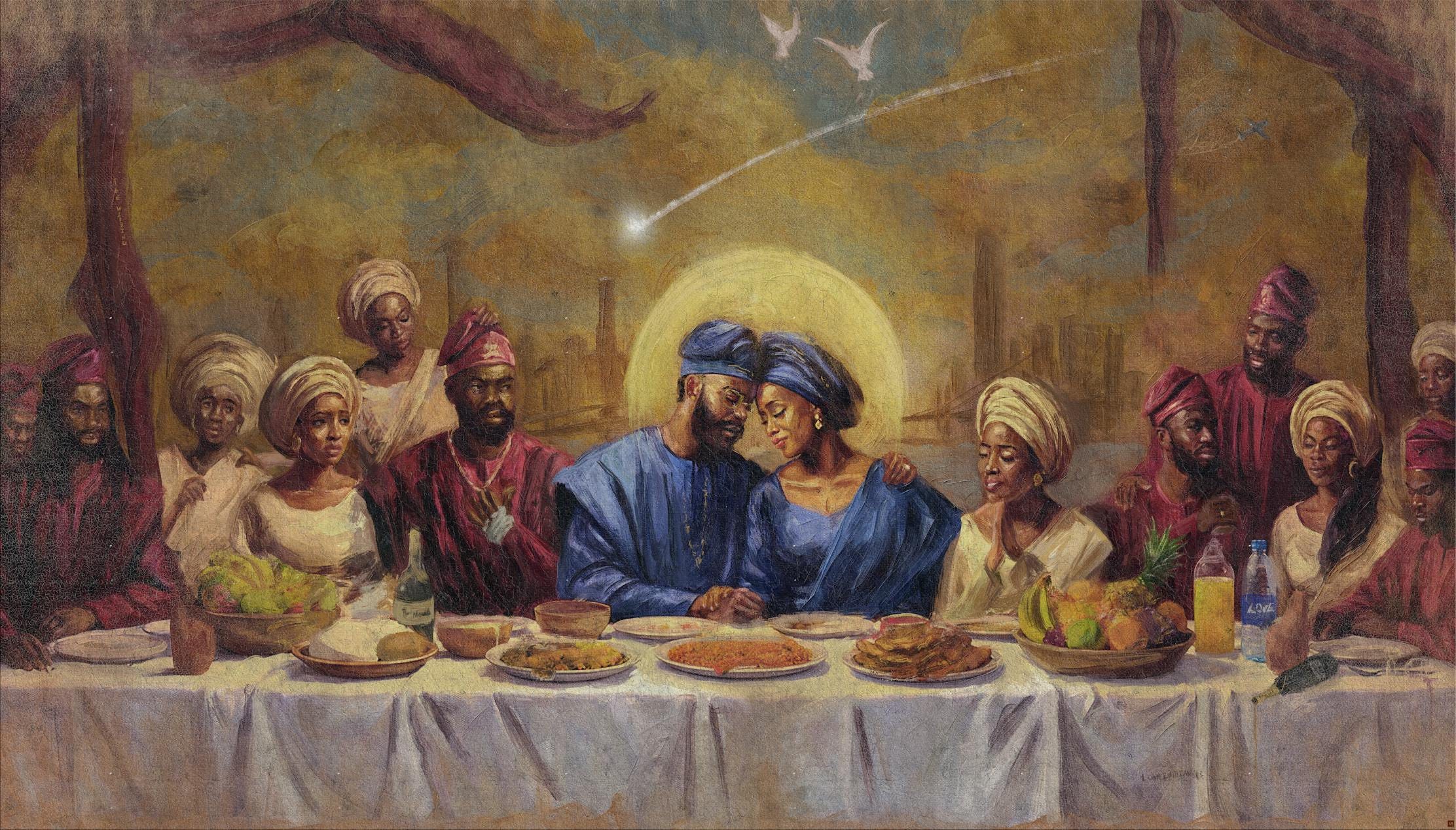
Quote of the Week
“The more horrifying this world becomes, the more art becomes abstract.”
Do you have some news that simply must be shared? Send us a DM
I remember Rare Art Festival in NYC 2019, 2020. It was just a room and someone decided to have an event.
Hackatao was staging their own solo exhibition in a town hall in Italy and invited a bunch of artists to show there.
Maybe I need to rent a room in Virginia and stage my own exhibition and cryptoart show.