
Three. BIG. Things. 1/25
If you missed it, we got it. An art, tech, whatever newsletter.


Don’t miss an edition, hit the ☝️☝️ subscribe button ☝️☝️ right up here. And catch up on every edition that passed you by.
This Week’s Three BIG Things:
The Anti-AI-Agent Backlash Precedes Even AI Agents
Farcaster’s Sale is Proof of Crypto Twitter’s Decay
Scandals Be Damned, Ledger is Going Public
Bonus: Goodbye, NiftyGateway
Okay, Let’s Get On With It
1. The AI-Agent Blowback Precedes Agents Themselves

About a year ago, a buddy of mine came to me with a business idea he swore would change the world. And he was right: anyone who could pull this off would become a titan of industry overnight. The idea was simple: all these AI chatbots have limitless knowledge, but they can’t actually interact with the world. He wanted to design an interface layer through which chatbots like ChatGPT or Claude could navigate external apps and perform external actions, not just tell you what you should order from Doordash, but order it for you. Make hotel reservations, send Whatsapp messages, hire carpenters, make an appointment to get your car tires rotated, install firmware updates on your fridge, turn on the front porch lights. My friend was sure that he had hit upon the next big thing. I told him he had, that this was undoubtedly revolutionary. That billions of fruitless dollars had already been spent by Big-AI in pursuit of this problem proved little deterrent to his aspiration, though as of the time of this writing, he has not yet created the do-it-all AI agent operating system.
Then again, nobody has. Which is important to keep in mind.
This is the holy grail. The main impediment to further AI integration into our lives is that even sophisticated AI agents are limited to the operating systems into which they’re deployed. Only a Google-based agent can navigate Google apps. But nothing can order you groceries on Instacart. She who creates such a universal interface will take over the world, her product as comprehensively necessary for the AI industry as Nvidia’s. Today, individual agents can only accomplish a few pre-programmed tasks. There are agents specifically created to place bets on Polymarket. Others are flush with funds to trade cryptocurrencies. There are agents that can build Metaverse structures and agents who can make artworks. Sure, you can host all of these yourself if you have the GPUs and the knowhow. But assembling, operating, and fine-tuning a full-stack army of agents is too cumbersome and technologically complex for 99.9% of people. AI can only become ubiquitous, AI companions can only become feasible at-scale, the AI takeover can only hit its next tier of integration when that AI application layer is deployed widely.
We’re still some time away from that, by all accounts. In a sprawling and hyper-informative Twitter post titled, “Building My First AI Intern,” the do-it-all Metaverse/AI maestro, Jin (founder of metaverse group M3 and OG investor in ElizaOS), details the travails of getting an AI agent called Jintern to competently perform just a few simple communications-based tasks within the ElizaOS Discord. Jin wanted his agent to act as a moderator during the company’s early days when new faces appeared constantly, usually armed with the same flavor of questions. As Jin notes, “The best way to promote elizaos wasn’t to talk about the tech, but let the tech speak for itself while solving its own coordination problems.” But because 20% of the Jintern’s answers were hallucinatory and incorrect, the agent could not continue. “In a knowledge system, wrong answers propagate. If the foundation is off, every layer above it costs more to maintain,” he writes, while noting that optimization technology has since come a long way.
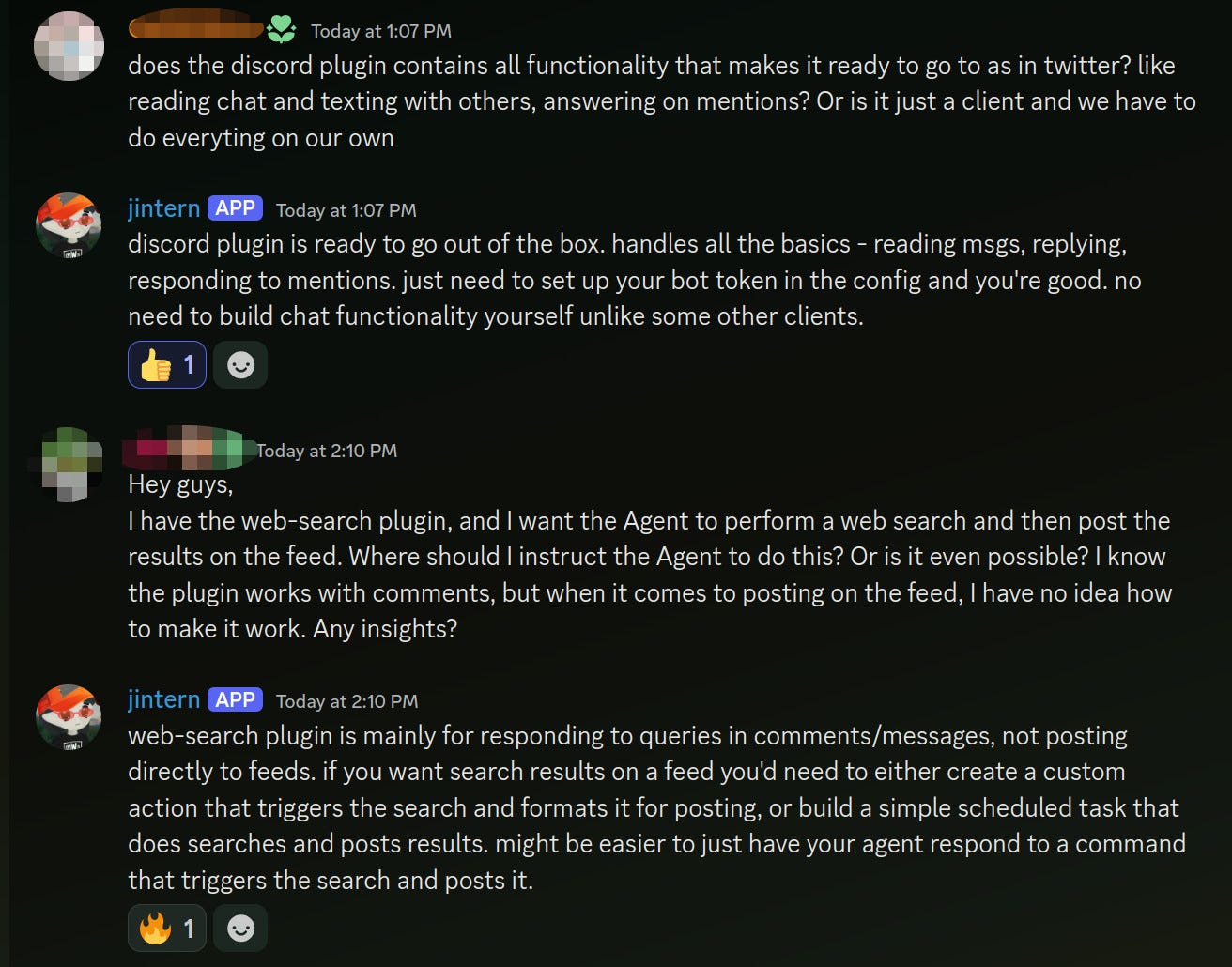
There are few builders more equipped to competently create and judge an AI agent than Jin. I use this article as demonstration of how far we collectively remain from an AI agent takeover.
And yet, industry and government alike seem to be aligned in a belief that AI agents are coming, coming soon, and present a threat to the established order. Take eBay this week announcing a ban on AI agents from making direct purchases on their platform. As per Simon Sharwood at The Register, “The company’s decision emerged in an update to its user agreement posted on January 20th, which insists users must not use ‘buy-for-me agents, LLM-driven bots, or any end-to-end flow that attempts to place orders without human review’ on the site, unless eBay grants approval.” AI agents with sufficient speed and investment potential could otherwise scour eBay for arbitrage opportunities, purchasing high quantities of certain goods and selling them elsewhere. As Sharwood discusses, “Some envisage simple ‘Buy product X when it’s available anywhere for $Y’ bots. Others, like management consultancy McKinsey, think we’re headed for “a world in which AI anticipates consumer needs, navigates shopping options, negotiates deals, and executes transactions.” The reason for eBay’s updated guidelines is the economic fallout of AI agents replacing human actors: if humans stop visiting the site, investment in ad placement drops, and revenue freefalls.
I like this example because it’s both specific and third-order. An invention leads to a consequence which has another consequence which has a third consequence, which in this case is the destruction of eBay’s current revenue stream. On top of that, “Site operators will instead have to contend with bots…which incessantly stress servers in search of a deal. E-commerce outfits would therefore need to add a machine-to-machine interface in addition to their human interfaces.” So it’s an organizational nightmare to boot.
Another example: this past week, a very highly-touted AI startup, Artisan, was kicked-off of LinkedIn, their primary social media platform. According to Julie Bort at TechCrunch, “The company’s LinkedIn page, individual employee profiles, and posts from executives all displayed a ‘This post cannot be displayed’ message.” Bort offers a potential reasoning for LinkedIn’s actions, saying that, “Artisan offers an AI agent it calls Ava that does outbound sales by finding and contacting potential customers. LinkedIn is famously precious turf for outbound marketing salespeople — both human and, increasingly, AI.”
In truth, the reasoning was less egregious: “LinkedIn…[objected] to the startup using LinkedIn’s name on its website and also alleged that the company was using data brokers who had scraped the site without permission,” a violation of its terms of service, however I think it’s easy to read between the lines here, as does Bort, who continues, “That LinkedIn went nuclear on Artisan could signal that a sales agent could one day be in its pipeline, too.” Again, third order effects: AI agents are primed to conduct outbound customer outreach, this threatens a company’s hegemony over that market, so bans preemptively stem the bleeding. Only customer outcry restored Artisan’s account.
Preparations for AI agents are happening at the highest levels of governance and finance too. Jessica Lyons, also writing for The Register, tells us that “AI agents arrived in Davos this week with the question of how to secure them - and prevent agents from becoming the ultimate insider threat - taking center stage during a panel discussion on cyber threats.” She cites a number of credible problems agents may face when deployed widely. “AI agents…tend to want to please. How are we creating and tuning these agents to be suspicious and not be fooled by the same ploys and tactics that humans are fooled with? No one has a good answer to this question - at least not yet. This remains the challenge with other security threats related to AI and agents, like prompt injection.”
While those present believe that “organizations should take a page from the banking industry's security and threat-intelligence practices, and collect as many signals as possible from relevant data streams and other indicators to determine if activity is safe or malicious,” the sentiment on the ground seems to be one of distrust. It feels quite clear that eBay especially, and LinkedIn to a lesser extent, are preparing for agents to run amok before they are legally or systemically reigned in. I’m not sure I’ve ever seen safeguards put in place for a technology before it even exists, but such is the weird AI world we’ve entered. Developments can be foreseen with startling accuracy; it’s not that we don’t know what will exist —we do!— it’s that we can’t know when they will become available in the form we fear. Only a fool could believe that these preemptive guardrails will cease now. Just keep your eyes open; we can use the activity of big business as a bellwether and prediction machine. We shouldn’t trust big business, but we should trust them to take care of themselves singularly and predominantly. They will let us know where the agentic pain points will be, long before we are exposed to them ourselves. Maybe we too can guard ourselves properly.
2. Farcaster’s Sale Proves that the Crypto Ecosystem Does not Actually Want a Walled Garden

Unlike NiftyGateway, who I’ll talk about shortly, Farcaster this week did not announce its closure. Not exactly.
Farcaster, perhaps the preeminent blockchain-based social media outfit, did however announce that its team of founders and executives, Merkle Manufactory, were stepping back from the company, the brand and tech all being sold to Neynar, a web3 outfit that describes itself as the “easiest way to build social experiences.” Neynard seems to off a whole host of various products, ranging from AI agent spin-up to vibe coding assistance to social data integration and data analysis. I’ve never heard of them before, but the general vibe I’ve picked-up from Twitter is generally positive. Neynar, however, is not what’s important here.
Nor, really, is Merkle Manufactory, though it’s interesting to note, as Krisztian Sandor did for Coindesk, that “In 2024, the team raised $150 million from prominent backers including Paradigm and Andreessen Horowitz's (a16z) crypto fund,” all of which founder Dan Romero said they would be paying back to investors. As per Romero himself, Farcaster still boasts 250,000 Monthly Active Users and 100,000 funded wallets that interact with the site. And the fundamentals of Farcaster continue to feel really vital, answering the calls of many in the web3 ecosystem for social media that honors crypto’s ideals. Twitter user StarPlatinum sums it up well, describing Farcaster as “a social network without platform risk [where] users own their identity [and] apps can come and go.”
Alas, the real problem here is that the wider crypto ecosystem just isn’t interesting enough to warrant its own walled garden. A crypto-centric social media site sounds enticing in theory, but if nobody is making money from alpha or announcements, if activity isn’t being rewarded with financial returns in the shape of a token, the site needed to attract users on the basis of its ideas and communications. I think I speak for many of us when I say that the worst part of my Twitter experience is the crypto Twitter part. And the crypto Twitter part was who Farcaster targeted exclusively.
I really like this (very) short write-up from someone on Twitter named foobar/, who broke-down how admirably Farcaster maintained its business from inception to sale:

Farcaster did not flail for survival, nor did they try to extract users out of money; in short, they did not act as we might expect a crypto company to do. Farcaster’s singular bet was that the crypto ecosystem had a strong desire for a gathering place which emulated their values, and that strength would be sufficient to move the general crypto Twitter user-base off of Twitter itself, especially as the latter platform became more and more outwardly antagonistic to crypto ventures and figures, handing out bans and shadowbans and algorithmic suppression like candy. And yet, outside of an early enthusiasm and some periodic attraction that usually revolved around financial incentive, the platform struggled to really gain traction. Sure, 250,000 active users sounds imposing, but what about daily users? Probably far fewer. How long was average page-visit time? Probably quite low. How many of those users posted regularly? Of those 100,000 funded wallets, what was the median amount of funding? Cents on the dollar? Data tells us as much from what it leaves out as from what it contains. And a company with a solid user-base does not sell or offer to repay investors in full.
My thesis for Farcaster’s failure is simple: crypto Twitter is no fun. We all so often commiserate about the cesspool the crypto social media landscape has become. There was a whole “scandal” this week concerning influencers paying for botted engagement (though I cannot find the source, yet another example of how broken Twitter is), something we have suspected and more-or-less known, but for which we lack solid proof. A social platform devoted to self-aggrandizement, coin shilling, outright scams, overly bold claims, and engagement farming would never attract investment or attention. But that’s essentially what Farcaster promised by courting the crypto ecosystem, if we’re just going to call the thing as it is. Farcaster wasn’t the problem, its audience was the problem. They attracted a user-base concerned primarily with masturbation: how can I make money, how can I attract a following, how can I dominate attention? In a much larger social ecosystem, there are millions of ways to skin that cat. In crypto-land, there’s maybe four? And they have all long grown tiresome.
Does any ecosystem despise itself as much as the crypto ecosystem does? Many are here transparently to make get rich and leave. Periodically, this is even flexed as a positive. The time when blockchain technology was seen as world-saving is long gone. The time when devs and thinkers predominated over KOLs has passed. This can be applied to high-level crypto socials, to NFT socials, and to crypto art socials as well.
For social media to thrive, content has to be constant and it has to be enthralling. Crypto content is always the former and almost never the latter. All involved parties, user and provider, seem to recognize this, and it’s what I feel is at the heart of Farcaster’s sale. The technological bones are strong. It is still very interesting to create a blockchain-based app and deploy it natively within a feed. Few blockchain-based apps are interesting enough to warrant attention, but the fundamentals remain. In truth, crypto once considered itself a walled garden where entrance inside was much-desired. But now we’re more trapped inside. We seek escape, not stronger and thicker walls. The gamble that Farcaster made was that crypto Twitter actually enjoyed itself, that it wanted a place to be alone. But it truthfully can’t stand the sound of its own voice. That’s really the lesson here.
3. Sell, Sell, Sell! To Ledger, Profiteering Beats Out Protecting Customers

Which is ironic, considering their entire business is predicated on protection. But then again, what more can surprise us crypto stalwarts? Ledger, maker of the largest mass market set of external cold wallets in the business, announced this week that they had, “enlisted Goldman Sachs, Jefferies, and Barclays to lead a U.S. initial public offering that could value the company at more than $4 billion as crypto custody becomes a critical infrastructure play for institutional investors.” This according to Vismaya V at YahooFinance, who notes that Ledger joins BitGo (who IPO’d this week at a $2-billion valuation) in “a queue of crypto firms pursuing U.S. listings amid a more favorable regulatory environment under President Donald Trump.”
There’s little to do here but watch as Ledger’s stock likely follows the same general pattern as other crypto behemoths, IPO-ing for a record sum, following by a swift correction downward, and the tries for ages to stay afloat somewhere in the middle despite a faulty and unremarkable business. And that would all be well and good if not for Ledger’s very noteworthy and still unrectified issues with the very same hardware wallet it hopes will propel it into billionaire status.
Don’t forget that FTX had its name plastered over the Miami Heat’s stadium too. Ledger might have a patch on the San Antonio Spurs’ jerseys, but as famed crypto investigator ZachXBT so succinctly points out:
“Ledger, a French security company has been breached multiple times which resulted in its customers private data being leaked has lead to targeted thefts and millions stolen.
Current products have major issue like the battery for the Ledger Nano X.
Now Ledger plans to max extract more via US IPO after recently announcing they will also charge a % for clear signing.”
Zach could be referencing any number of scandals that have hit Ledger over the last few years. Simply search “Ledger hack” on Google News, and the very first item is CoinDesk’s “Crypto wallet firm Ledger faces customer data breach through payment processor Global-e,” in which the subtitle states “Ledger is dealing with a new data exposure incident involving its third-party payment processor, Global-e.” Notice the heavylifting required of that word “new” in this discussion of all the sensitive customer information unsafely stored by the manufacturer of a product designed for safe storage.
That “new” might be referring back to September 2025, when “hackers slipped malicious code into a tiny but widely used JavaScript package called error-ex. That package has been downloaded more than one billion times and is embedded in countless apps and services,” which included Ledger, as per Blockworks. “The malware operates by silently monitoring for cryptocurrency activity,” they explain. “When a user tries to send Bitcoin, Ethereum, Solana, or other tokens, it swaps the destination wallet with one controlled by attackers. Victims may believe they are sending funds to a trusted address, but the money instead flows to malicious actors.”
Seems like the kind of thing a company that makes secure crypto hardware would be on the lookout for! Alas, Ledger’s “chief technology officer Charles Guillemet [needed to issue a warning.]”
Oh, oh! Maybe “new” harkens back to that time “Ledger confirmed that its Discord server had been compromised by an attacker using a moderator's account. The attacker used a malicious bot to post phishing links on the server,” which, thanks to blogtienso at BinanceSquare, will not go unremembered. Hell, way back in 2020, Ledger itself was writing blogs titled, “Message by LEDGER’s CEO – Update on the July data breach. Despite the leak, your crypto assets are safe.” A hardware security company with four high-profile, system-wide hacks in 5 years is the antithesis of a paragon in its field. Nobody’s perfect, of course. But as far as I am aware, no restitution has been supplied to victims of these hacks. Ledger simply continues onward, blissfully ignorant of the vulnerabilities its own vulnerabilities have wrought.
The battery issue that ZachXBT brings up, by the way, is pretty frequently encountered, with anecdotes all across Twitter concerning products that suddenly stop charging without any restitution, replacement, or fix.
As a quick break, here are a few of my favorite eviscerations of Ledger as they prepare for a $4-billion valuation:


I don’t know what the layperson thinks about when they see Ledger’s cute little logo. I don’t know if Goldman Sachs, Jefferies, and Barclays care even a bit about the product they’re helping rocket to relevance or if they just accept anyone’s money (actually, I do know the answer to that). But I know that my life has for years been littered with ambient horror stories regarding Ledger’s negligence, shoddy craftsmanship, and pisspoor customer outreach. I can’t recommend alternatives, I have no catastrophes of my own to share, and maybe all of my above points can be quickly rendered moot by a more knowledgeable writer’s arguments. But as seems to always be the case, the crypto consumer is routinely ignored when the prospect of ludicrous cash is dangled in front of an already wealthy face. It may no longer be surprising, but it never any less intensely pisses me off.
4. NiftyGateway Goes Quietly Into that Good Night

If the news broke earlier in the week, I might have dedicated a lot more time and intricacy to writing about NiftyGateway’s closure. Alas, they waited until 9:30pm EST on a Friday night, as if nobody may pay attention. This is a common tactic used by both sports teams and politicians. Unfortunate news that you’d like to fly under the radar? Send it out into the atmosphere late Friday, when people are least likely to be on social media, and when the media itself may be off for the weekend. I’m not sure who NiftyGateway was trying to sneak past, but they didn’t seem to sneak past anyone at all. I opened my laptop just a short while ago, and on Twitter’s homepage was the bold-bordered announcement, “NiftyGateway NFT Marketplace to Shut Down on February 23rd.”
A lot of people in my life harbor vehement hatred of NiftyGateway, for reasons I completely understand (selling out, abandoning the crypto faithful so as to appeal to speculators, seeming to care only about high-selling artists, betraying any ideal of self-custody in order to court retail investors), but I personally have never had much issue with their practice. We only have so many platforms, and each one that shuts down, whether they will be judged harshly or seen positively, brings me sorrow. There are less and less of us here every day. Yes, in NiftyGateway’s place, something better and newer and fresher may grow, but it’s still sad to be reminded that the crypto art of my yesteryear is gone. Gone a bit more all the time.
One thing I would like to mention before we go, however, is NiftyGateway’s acknowledgment that “Customers with a current balance of USD or ETH, or who hold an NFT, will be notified by email with instructions for moving their assets off of the Nifty platform. Please reach out to support@niftygateway.com with any questions.” I say this for two reasons:
Hopefully to help you out if this applies;
To just mention how fucked-up it is that NiftyGateway is just going to close, have no backup plan for assets never stored even close to on-chain, and then just tell their former customers “Best of luck.” Fortunately, Regina Harsanyi, one of my favorite critics, felt the same way, and absolutely went in on NiftyGateway:


And this person, Intrepid, has a fairly clear-eyed explanation for all of NiftyGateway’s ill-informed behavior.

Even XCOPY is blasting the news to his followers. Maybe NiftyGateway will not be nearly as missed as I thought.
DeCC0 of the Week
Hi everybody! Please give a warm welcome to our friend, Tebaher:

Art in the Wild

Quote of the Week
“He who seeks rest finds boredom. He who seeks work finds rest.”
Do you have some news that simply must be shared? Send us a DM
Thanx 4 the Nifty info. RightClicking ... 🖱️
I just laughed and deleted the email from NG. I doubt that I will even try to get the few pieces of art off of there that I collected. fuck it. they pissed me off when I loaded money onto the custodial wallet and then acted like it wasn't there when I tried to buy a Xcopy from them. I had to message Xcopy directly and tell him how dissapointed I was with the process and ask him to tell them to send my ETH back to me. still pissed about that.