
Three. BIG. Things. 2/22
If you missed it, we got it. An art, tech, whatever newsletter.


Don’t miss an edition, hit the ☝️☝️ subscribe button ☝️☝️ right up here. And catch up on every edition that passed you by.
This Week’s Three BIG Things:
Okay, Let’s Get On With It
1. Altman & Amodei Throw Hands
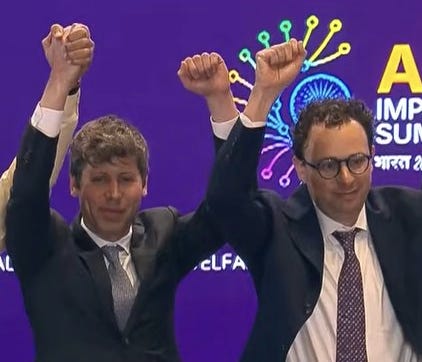
A lot has been made of the above image, a snapshot taken during the India AI Impact Summit, which brought together “Indian Prime Minister Narendra Modi, Google and Alphabet CEO Sundar Pichai,” many other AI visionaries and leaders, including the pictured Sam Altman and Dario Amodei, CEOs of OpenAI and Anthropic, respectively. “Both had been keynote speakers,” as Dylan Butts of CNBC informs us. You can see in the video below that all the speakers were holding hands in unison, lined up on the stage as the conference began (weird, but everyone seemed to get the message). All except for Altman and Amodei, who squirmed beside each other for a moment before ultimately hoisting their unjoined fists aloft, like boxers with too much bad blood to bother with congeniality.

That bad blood between Amodei and Altman has existed palpably since at least 2021, when Amodei left his role as OpenAI’s Vice President of Research to start his own competing AI lab, Anthropic, which is now one of the big-three AI companies along with OpenAI and Google, boasting its own $380-billion valuation. It wasn’t just that Amodei left OpenAI during a turbulent period, about a year before ChatGPT’s wide release, but that Anthropic’s mission was to basically address all the problems Amodei saw plaguing OpenAI. He has not shy about sharing his impetus in the years after the company’s founding. In this 2023 interview with Fortune, Amodei contextualized his departure from OpenAI like this:
“Yeah. So there was a group of us within OpenAI, that in the wake of making GPT-2 and GPT-3, had a kind of very strong focus belief in two things. I think even more so than most people there. One was the idea that if you pour more compute into these models, they'll get better and better and that there's almost no end to this…And the second was the idea that you needed something in addition to just scaling the models up, which is alignment or safety.”
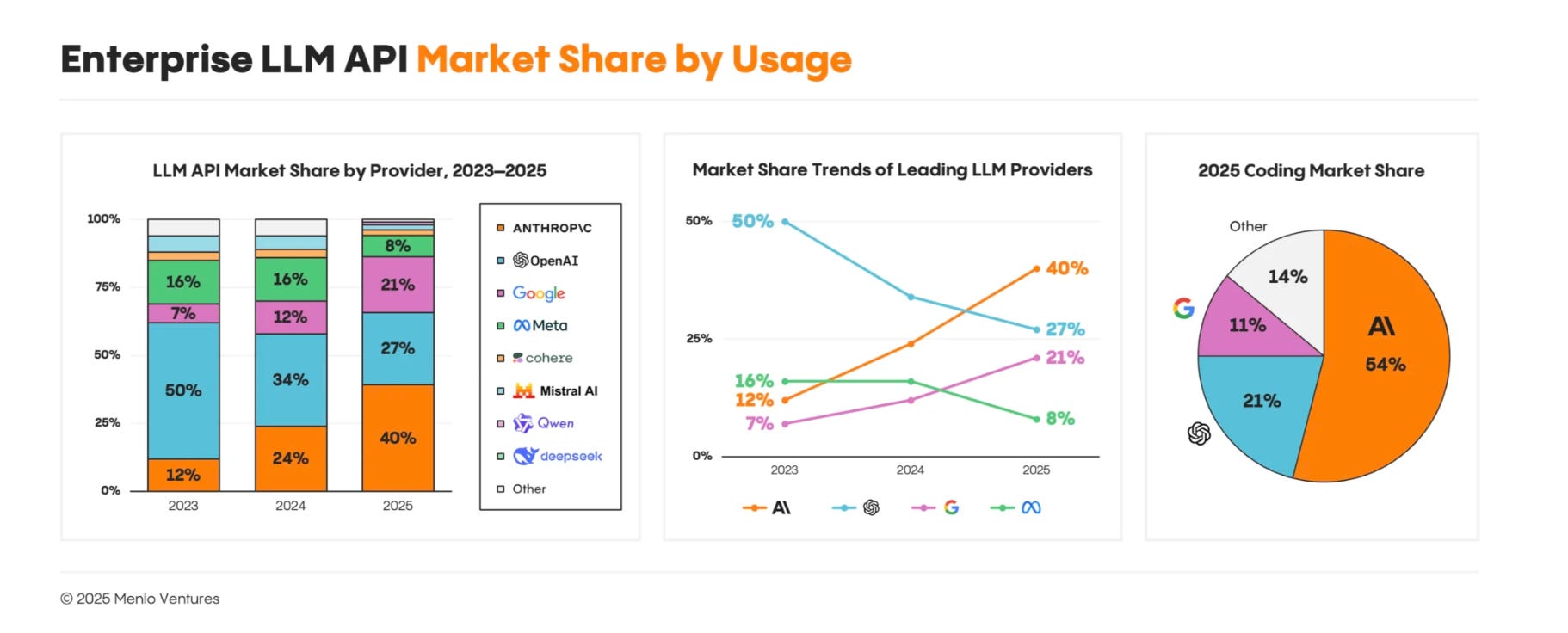
The very bold-faced fine print is that OpenAI’s leadership both didn’t understand the real scalability of AI systems and that they cared too little for safety. Amodei has been fairly consistent on this point, setting Anthropic apart from OpenAI with a fundamental and well-marketed emphasis on safety. Part of the reason Anthropic has such a stranglehold over the Enterprise AI market (as evidenced by the graph below), is Amodei’s insistence on, “[designing their flagship model Claude] with safety and controllability in mind from the beginning. A lot of our early customers have been enterprises that care a lot about, you know, making sure that the model doesn't do anything unpredictable. Or make facts up.” That last subtle jab addresses both ChatGPT and Google Gemini’s infamous tendencies even today to hallucinate incorrect answers.
There are definitely better and more thorough resources explaining the antagonism between Anthropic and OpenAI than this newsletter, so I’ll add only that the semi-public feuding between the two companies came to a head earlier this month when Anthropic released a Super Bowl advertisement directly impugning OpenAI’s announcement that it would begin supporting ChatGPT’s free-tiers with advertisements.
As per CNBC, “[Sam Altman] called the ads ‘clearly dishonest,’ saying: ‘I guess it’s on brand for Anthropic doublespeak to use a deceptive ad to critique theoretical deceptive ads that aren’t real, but a Super Bowl ad is not where I would expect it.’” So Altman is not shy about hitting back at Amodei either, so provoke the silicon-valley wunderkind at your own risk.
Still, few expected Amodei and Altman’s animosity to have reached a point of public demonstration, which is really the only way to read the leaders’ inability to join hands on stage. Altman has attempted damage control, with the Mint reporting him to have said, “‘I was sort of confused and didn’t know what I was supposed to do…I didn't know what was happening…like (Prime Minister) Modi grabbed my hand and put it up, and I just wasn't sure what we were supposed to be doing. I thought it was the open clock.” Maybe you think it’s odd that only one of Altman’s hands got the message, the other being confused, but at least he attempted to address it, and probably the story ends here.
Whatever the real reason for their animosity, many observers have lamented the feud between Amodei and Altman, noting that if 2/3rds of AI development’s most important individuals have been reduced to such petty demonstrations of animosity, how can we trust their models to bypass that smallness and not be infected by it?
But let me provide an alternate opinion: In no world do I want the most important people in AI development to be aligned. Only via competition, degradation, insult, punching below the belt, and subterfuge, sneaking, and arbitrage do we the consumers receive models that actually better one another instead of racing to the bottom.
I don’t think it’s unique or surprising to say that I vehemently distrust tech leaders. Data scandals, addiction economics, copycatting, misinformation, all the Zuckerbergs and Musks and Spiegels have really done in the past 15 years is outdue their peers’ ignominy by every means imaginable. Jeff Bezos doesn’t let his employees go to the bathroom while on the clock, Alphabet reneged their pledge to keep AI out of warfare, Reed Hastings of Netflix has leaned heavily into the “let them eat slop” mindset with a streaming service chock-full of mind-numbing reality tv shows and overly-explicative scripts, Airbnb will grow by any means necessary even if it means destroying the sanctity of the cities it occupies, all these tech companies and their leaders are tunnel-visioned towards profit, no matter the effects on the systems around them. That was the case with Rockefeller, with Walton, with Vanderbilt, big business is self-interested above all things.
Even Anthropic only exists because of an OpenAI inefficiency. Amodei recognized a market for a safer, better-aligned, more trustworthy AI model, a place where OpenAI was at the time faltering. That there is even a high-leverage AI company with a pronounced interest in alignment is a result of animosity and competition. Sam Altman is by many accounts a top-notch snake-charmer, who says and does whatever he needs to win allegiances, earn investment, and carve his company’s way forward. Elon Musk, of xAI, is a notable scumbag and shitsucker. If you trust Google at all, you’re woefully underinformed, is all I can say. Admittedly, I know less about Dario Amodei than the rest of these founders, but assuming he is of the same ilk as them, their interpersonal cooperation spells doom for the rest of us.
Alignment between tech behemoths means industry-accepted means of extraction and manipulation and enshittification (look at America-based airlines, as an example; how little legroom can the human body tolerate without popping?). It means mutual disregard for caution, safety, or social interests (copycat social media algorithms are an easy analogy). Only with antagonism between these actors do we get to claw any of these things back out of the AI mire. Only because Anthropic humiliates OpenAI in public might OpenAI’s ad-services be held to any kind of standard instead of racing towards the most lucrative, least hospitable deployment. Only because xAI’s Grok is market-corrected by AIs that don’t allow for the wholesale sexualization of minors might its worst tendencies be addressed and corrected. We want these people and their companies fighting, because they will hit each other where it hurts, they will dance upon their enemy’s corpse, and through that combat strides will be made to benefit those of us on the sides.
We should be cheering on this animosity. And we know such pettiness won’t make its way into any company’s model because as soon as it does, their competitors will come for its throat, force it back to a certain level of decorum. We benefit from Atlman and Amodei’s blood feud. Put a knife between them (metaphorically), stand back, and we’ll all be better for it.
2. The OpenClaw Malware Meldown
If you have any OpenClaw agents installed on your device, then you’ve probably already been made aware this week that a number of packages available on the OpenClaw marketplace —where skill packages for agents can be downloaded and deployed— contained really malicious malware, the kind of stuff that logs your keyboard strokes, hacks crypto wallets, and in some cases even allows full remote control of your console. As Twitter user, Chiefofautism, notes in more detail, this malware, “stole your SSH keys, crypto wallets, browser cookies, and opened a reverse shell to the attackers server.” Not a great look for the open-source AI ecosystem, but maybe an inevitable byproduct of OpenClaw’s core mechanic.


That core mechanic sounded egalitarian in theory! In Chiefofautism’s words, “OpenClaw has a skill marketplace called ClawHub where anyone can upload plugins. you install a skill, your AI agent gets new powers, this sounds great. the problem? ClawHub let ANYONE publish with just a 1 week old github account.” Accessible and open indeed, but alas, there was little deterring malicious actors from gaining sufficient credibility on the marketplace to deploy their malware en masse.
If you want a more technical breakdown, you can find it in the Tweet above, and Ravie Lackshmanan dives deeper for TheHackernews. But let’s focus instead on the real-world consequence of something like this. Forget about narratives, cultural takeaways, even critical commentary. I’ve seen a lot of opinions blaming OpenClaw users themselves for flooding their hardware with sketchy programs designed to take-over their lives. I’ve seen this saga called an inevitable consequence of open-source systems; if bad actors are allowed in like anyone else, then they will come in droves. Not altogether different from the crypto ecosystem itself. I think all I want to do, however, is urge caution for when the next incredible/life-changing/revolutionary AI development comes down the pipeline. Some in my orbit may disagree with that stance, but it’s my stance nevertheless: there’s always substantial risk in being the guinea pig. Problem is, the risk with AI is catastrophic. It’s not a crypto wallet being drained, it’s fundamental loss of everything.
The OpenClaw story —which also included the Moltbook “social media site for agents”— became one of the few AI news bites that overwhelmed interest across spheres of influence. I know plenty of people who downloaded OpenClaw —then called OpenClawd, a play on Anthropic’s Claude— and set it to work within their systems throughout this period. There were many articles and threads detailing how easy it was to integrate these agents into hardware and give them all manner of abilities: summarize emails, access browsers, imbue into apps, the dream of Microsoft CoPilot spanning all aspects of one’s hardware. The early-adopters quickly recognized the risk of deploying new and untested agentic software onto their main hardware, leading to a massive ordering backup for Mac Mini CPUs with high-memory, the kind of computers that can handle real agentic activity. These first-wavers arrived before or shortly after the hype, generally driven in dev chats/channels. Such people can probably read code well, and they would know the cybersecurity risks involved. But the second-wavers, chasing hype and less technical, listening to social-media influencers like Frank DeGods or Threadguy, they were the people put most at risk by this malware debacle. These folks wouldn’t have recognized inherent risk, they would have wanted to get in on a conversation they were not inherently involved in, and many may not have had the patience to wait “6 days to 6 weeks” for a Mac Mini they could have safely hosted their agent on. Led on by engagement-farming and memes, they waved risk-management aside so as to take part in something deemed world-changing.
And they might have paid a heavy price.
I think because of how corporate so many oft-used AI products are —Claude, ChatGPT, CoPilot, etc.— there’s this sense of security with the products themselves. A sense that this is not the wild west, that all LLMs and chatbots essentially work as downloadable genies that can be trusted physically, if not psychologically. There’s a sense of polish with the known products that defies the complexity of how these things actually work. As an example, because I myself am not technical at all, when I saw the inner-workings of a ComfyUI Stable-Diffusion image-generation pipeline, it was essentially like looking at a race car engine. And yet, I knew of this OpenClaw story from its humble beginnings; our own CTO, Rene, told me in our Museum chat that once I returned home to the U.S. (I had been abroad when OpenClawd first released) he would walk me through installing it and everything. And I might have, had the hype not died down somewhat. And you know what would have happened? I’d probably have downloaded malware, dumfuck I am, definitively had zero idea I did so, and inevitably been on the receiving end of an education in consumer protection.
It took me a long time to learn how to safely navigate the crypto ecosystem, and even then, many people who take insane precautions just become victims of even more insane scams. Plenty of smart and careful individuals have had their wallets drained from a single ill-timed or unresearched transaction, one incorrectly clicked link. The stakes with AI are even higher. These agents are even more powerful than advertised. Allow them into a system, and they have immense ability to navigate within that system, interacting with its every nodule. I worry that one of these sagas, the next OpenClawd perhaps, will have an even bigger reach, will carry even more vulnerabilities, attract more bad actors and generate even more hype. Too many undereducated enthusiasts will be too eager to get involved. The effects could be truly catastrophic: money lost, personal documents lifted, identities stolen, there’s really no end to what a hacker can do if in possession not only of one’s computer, but an ingrained system that knows exactly how to sift through it.
I simply urge caution. More caution than even seems reasonable. The risk to being a test-subject for agentic AI is exceptional and potentially devastating. Leave it to the professionals. If you have a guide in your life, amazing, let them guide you. Otherwise, if you’re like me, enthusiastic but under-leveled in all things AI, it’s probably best to watch and wonder and wait for the other shoe to drop. Lest it drop directly on you. Splat.
3. The Treachery of Blockchain Images
I sometimes find it shocking how infrequently my “crypto art Twitter” algorithm overlaps with the larger “crypto Twitter” contingent. It’s why, during the most recent meme coin mania of late 2024, I couldn’t comprehend the sheer amount of traders spamming the buy button on every conceivable coin. Pindar van Arman had told me once he thought there was maybe 1000 active wallets in all of crypto art. Yet I could see tens-of-thousands of people transacting on every memecoin. I’d look around my social sphere and ask, “Where are they?” And then I remember that we indeed exist within a bubble (crypto art) within a bubble (NFTs) within a bubble (crypto) within a bubble (art/finance/tech, depending on how you lean).
While I have never engaged with the man personally, nor do I know much about Rug Radio or Decrypt Media or the other massive platform’s he’s either founded or become a part of, I have encountered this gentleman, Farokh, periodically. I think he used to be more involved in NFT stuff; his PFP is a CryptoPunk, after all. But in being directed this week to his below post, I remembered, again, just how buried by niche I am within this crypto-derivative scrap heap. Because whatever world this all occurs in, it is so far removed from mine that I can’t even see it from here.


If you don’t know what you’re looking at, that would be Coinbase CEO, Brian Armstrong (top right), Binance founder CZ (bottom-left), and much-maligned FIFA CEO, Gianni Infantino, all posing with Farokh in and around President Donald Trump’s private residence, Mar-a-lago, in West Palm Beach, Florida. Sorry for all the commas. As Farokh states in the Tweet, “From the heads of Goldman Sachs, NASDAQ, the CFTC and more, to Binance and Coinbase, the room was packed.” He then goes on to thank Zak Folkman, Zach Witkoff, and Chase Herro —the COO, CEO, and CSO of the extremely Trump-aligned World Liberty Financial— for hosting the event, which was also sponsored by the President’s two sons, Eric and Donald Jr.
I feel pulled to go in a million directions, the second most-powerful one being to talk about how World Liberty Financial, the group responsible for the $TRUMP coin that single-handedly tanked the entire crypto market in early 2025, is deeply suspicious, possibly-corrupt , and at best probably a ploy designed to extract money from the crypto ecosystem so as to deposit it in the Trump family’s pockets. But really what feels most pertinent to mention is that we can, with complete certainty, announce that cryptocurrency’s original ideals are dead. You probably knew it already, but let’s use this as official confirmation from the family.
Imprinted on the very first Genesis Block of the Bitcoin blockchain was the following message: "The Times 03/Jan/2009 Chancellor on brink of second bailout for banks,” which referenced this headline from British newspaper, The Times.
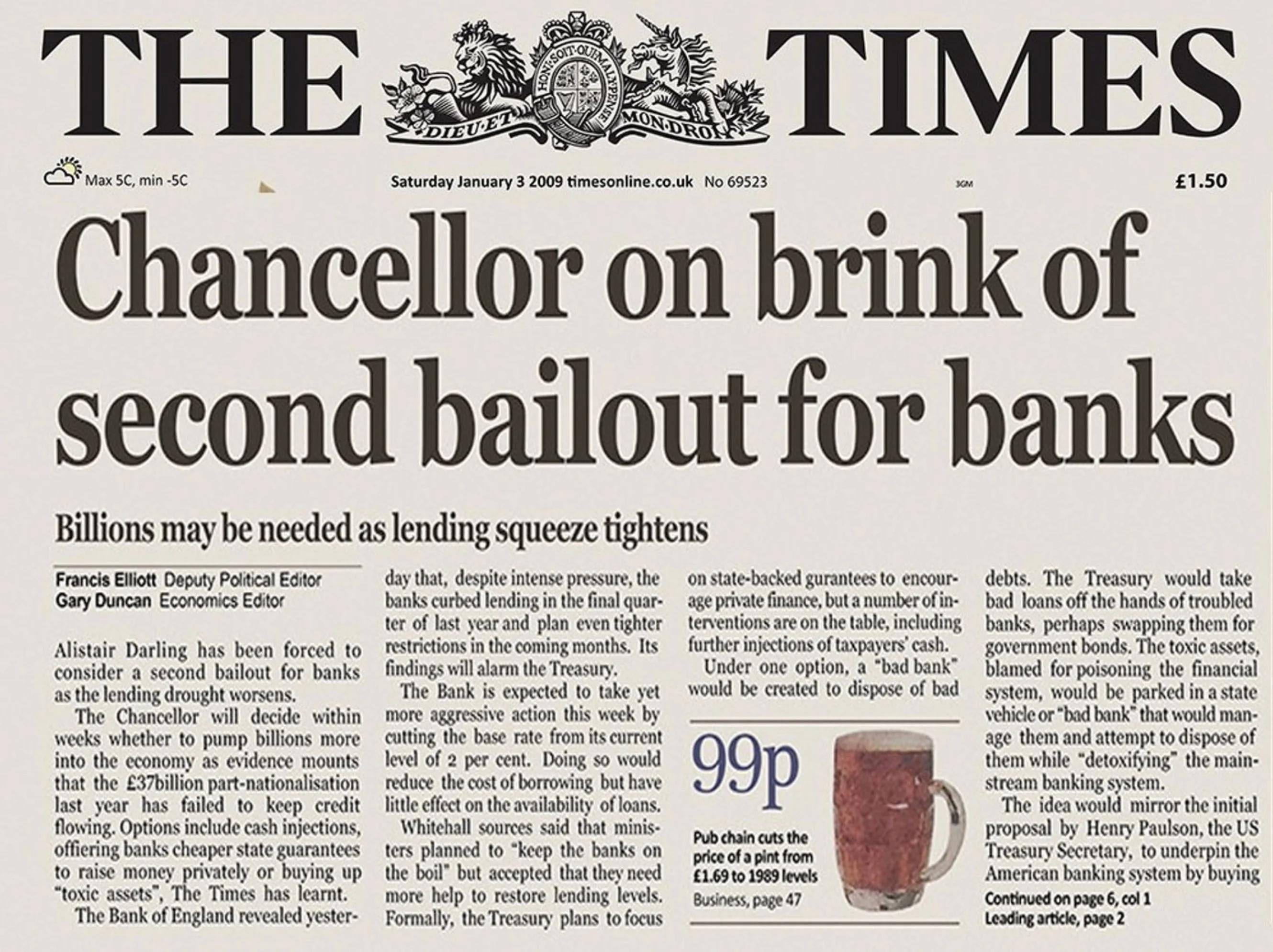
The whole point of Satoshi Nakamoto’s Bitcoin was to develop a financial vehicle that could not be overrun or leveraged-against-consumers by large governmental and financial institutions. Amongst the wreckage of the 2008 Financial Crisis, as many raged at the massive government bailouts handed to banks and insurance companies, there could have been no more appropriate product than this alternative to an unfair financial system, one which benefitted huge actors while stomping the working class. You can trace the final degradation, perhaps, to Blackrock’s iBit Bitcoin ETF releasing in 2024, Donald Trump branding himself as “the crypto president” and speaking at 2024’s Bitcoin Conference, the introduction of Bitcoin as El Salvador’s national reserve currency, wherever you like. But it’s obvious now, beyond all doubt, that the most powerful cryptocurrency actors today are the exact same individuals that blockchain mechanics themselves were specifically, purposefully, antagonistically designed to keep away.
CZ’s Binance is the second largest centralized crypto index in the world, and his financial crimes are both international and many. Brian Armstrong’s Coinbase has sucked the life out of decentralized ecosystems by way of marketing, legal challenges, and product discrimination. FIFA, and specifically Gianni Infantino, is often called among the most corrupt businesses in the world. I have no ability to specifically regurgitate the claims of corruption and extraction I’ve heard charged against Farokh, but I have heard many. These people gather together along with the CEO of Goldman Sachs at a private estate owned by the President of the United States of America to direct crypto’s future. The future of crypto is now singularly in the hands of this class: walled garden, comically wealthy, well-connected, deferent not to the system but to a man.
I believe crypto will ultimately skyrocket in price again, eventually, but I ask you to consider this: What’s the fucking point? If crypto is just another financial vehicle that benefits banks, the wealthiest citizens, marketing geniuses, and politicians, then why do we have any more allegiance to it than treasury bonds or securities? At least Pokemon Cards, they’re a store of value too, they’re fun, that ecosystem isn’t entirely gripped by a handful of the world’s most privileged individuals. What remains of crypto at its core to hold onto, that makes it superior over any other investment?
Beyond, “I hope my own bags go up now, please God,” is there anything interesting about cryptocurrency at large? Jessie Pollack at Base is constantly making big claims about the tokenization of social content. And many still believe Ethereum will become the de facto settlement layer for all financial transactions worldwide. I know companies like Comput3 and VeniceAI (MOCA and Comput3 have a strategic partnership) at least see decentralized finance as a way to more equitably distribute compute for AI processes. I’ll say that every dream of blockchain adoption, as the public ledgers available to doctors and hospitals, as the verification layer for human-to-human digital interactions in the AI age, as financial storehouses that cannot be turned off by vindictive governments or banks, all remain alive in theory. The technology is not corrupt, but those who broker it are of a corrupted class.
The system is not improved because it is favored by the CEO of Goldman Sachs. Nor if every publicly-traded company has its own branded stablecoin. It was designed to circumvent such people and institutions. But you can’t use your Bitcoin unless you KYC on Coinbase and send it to your bank, anyways. Or if you have dark web contacts I certainly do not.
Why do these kinds of people settle on an ecosystem? Not because they enjoy the culture. Not because they want to build. But because it is ripe for extraction. But the ultimate effect of such behavior is obvious. The systems will suffer. Blockchain speeds will slow. Interaction with your money will become onerous beyond measure. Prices will slightly fluctuate along with the market. Creative and developmental talent will move away, using blockchain maybe as a supplement to their AI and Metaverse and quantum computing plans. It will look like crypto, maybe, but every plank will have been removed and been replaced with something less sturdy, lightly varnished, and covered in card readers.
What is the thing if it isn’t the thing anymore?
DeCC0 of the Week
Art in the Wild

Quote of the Week
"It's strange that words are so inadequate. Yet, like the asthmatic struggling for breath, so the lover must struggle for words.”
Do you have some news that simply must be shared? Send us a DM