
Three. BIG. Things. 2/9
If you missed it, we got it. An art, tech, whatever newsletter.


I we’re a day late this week, but please forgive me, I was traveling all weekend, and my brain was in six places.
Before We Get Into This Week’s Three BIG Things:
This is the most important thing you’ll read today, from Nedtzo:

This Week’s Three BIG Things:
Catching-Up with the Teacherless “AI School”
OpenAI Makes a Big Bet on Agents
My Complicated Feelings About Batsoupyum’s Emerging Artist Fund
Okay, Let’s Get On With It
1. Reexamining an AI-led School System, 9 Months Later

In May, I stumbled upon the fascinating case of Alpha School, a private K-12 school network, which is notable for a few reasons:
At Alpha, traditional teachers are replaced with student-specific AI programs. Human “guides” are instead present to encourage students.
Traditional classroom study is limited to 2-hours a day, where “students use laptops for 30-minute sessions in core academic subjects, including math, English, science and social studies. The personalized approach utilizes proprietary and third-party apps and allows students to master topics up to five times faster than traditional methods,” as per Joshua Rhett Miller for Newsweek, pulling from Alpha’s own description.
The rest of every school day is be spent developing “life skills,” including financial literacy, public speaking, coding, various forms of athletics and exercise, etc.
Students’ overall grades and test-scoring were “in the ‘top 2 percent’ of test scores in the country,” at least according to education benchmarks laid-out by the Northwest Evaluation Association's Measures of Academic Progress.
In May last year, Alpha was preparing to open a school in New York City, which they did in September while also expanding impressively throughout the lower 48 contiguous American states. I’m not exactly sure why Alpha School has in the past few weeks been discovered by a host of mainstream news outlets, including CNN, BusinessInsider, and ABCNews, but I wanted to touch again on where Alpha Schools are at. Their promise —using AI to create a fundamentally more enjoyable and more successful educational experience— has too much groundbreaking potential to be ignored.
Like I said, since we last talked about Alpha School, their footprint has expanded massively. They now boast 13 physical locations with 22 total planned, including six in California, that big shiny new one in New York City, a Chicago branch, one outside of Charlotte, North Carolina and another in the state’s famous research triangle. So, clearly, whether because they’re seeking wealthy clientele or trying to build influence where influence coagulates, Alpha is choosing high-visibility locations. As per Melanie Woodrow at ABC7News, “Alpha School…opened in San Francisco's Marina neighborhood this academic year…and is looking to expand with campuses in Palo Alto and the East Bay due to growing demand,” so the expansion is borderline aggressive in key demographics. Maybe that’s because few other locales can comfortably pay “Alpha's $75,000 a year tuition,” costing almost as much as an American private university (though other locations charge as little as $10,000 (CNN)).
Writing for CNN, Sunlen Serfaty, Linda Gaudino, and Nicky Robertson note how, “Alpha declined several months of requests from CNN reporters to visit its campuses or speak to Price, its co-founder…(The company told CNN last autumn that they had ‘paused’ non-essential visits as they ‘fielded 15-20 requests per day from not only media but national and international academic institutions, school leaders around the world’”). Finally getting access, their buzzy “‘What if I told you this school had no teachers?’: Is AI schooling the future of education — or a risky bet?” is probably the most comprehensive existing discussion of everything Alpha-related. Interestingly, this includes not only a recent backlash, but how Alpha itself handled criticism. As per CNN (and backed-up by Wired, though I don’t have full access to the article),
“According to documents and communications from the 2023-2024 school year seen by CNN, some half a dozen families voiced concerns about the efficacy of [Alpha’s] teaching model and the anxiety the school’s culture and AI-set learning targets were placing on their children.
Some students were ‘so stressed out’ and yet the school was ‘propping them up as, like, the model’ and ‘evidence why Alpha works,’ Jessica Lopez, one of the most vocal parents, told CNN this year, when speaking of the experience. She withdrew her two daughters from the school in 2024.
Sure, the efficacy of Alpha’s model shouldn’t necessarily be thrown away because it does not have uniform success. But Alpha addressed these concerns oddly. The more I read about Alpha, the more I see that their founder, Mackenzie Price, has a serious Silicon Valley cult of personality around her; she’s centered in many of these articles, she’s doing all the media blitzing, she has a podcast, and she personally fielded the aforementioned Jessica Lopez’ termination request for her daughters. A Stanford graduate, Price partnered with “technology billionaire Joe Liemandt, founder of Trilogy Software and private equity firm ESW Capital,” to start the schools, and their responses reek of technocrat diffusion of blame. CNN quotes their response in full, writing:
“Alpha has denied any link between its schools and anxiety and noted the Brownsville [location that the Lopez’ attended] has changed from a homeschool-hybrid model that was ‘confusing and ineffective’ and bears ‘no resemblance to the school model today.’
“‘The entire school experience, pedagogy and approach to learning have transformed dramatically,’ including its apps, goals, workshops and other parts of the school system, the company said. ‘There is no accurate or fair way’ to hold the Brownsville experience from those early years ‘as representative of the current Alpha student or school experience,’ the school said, adding that Alpha now has many families across all of its campuses who have positive experiences.”
Mind you, the issue in question occurred only two years ago, so it does make one wonder how much they could have transformed their entire methodology in a two-year period that also saw the company rapidly expanding. Certainly, AI development is moving quickly, but if we’re measuring the efficacy of education on a cohort of students, a more longitudinal examination would necessarily be required than half an average student’s time spent in high school. But one largee change from May is that the efficacy of Alpha’s claims are more clearly in question than they were then. Again according to CNN,
“‘What has been a big concern amongst scholars and researchers is that Alpha is refusing to allow for any independent research to evaluate the claims or to really scrutinize what’s going on from disinterested parties,’ said Victor Lee, an associate professor at Stanford University’s Graduate School of Education.
“‘That sort of behavior sort of implies there’s something to hide,’ he said, adding that he found some of Alpha’s claims of success ‘dubious.’”
As I often do, I like to get some background information from Reddit. Sure, there’s much less onus on research but one gets a more boots-on-the-ground emotional perspective. I won’t generally quote Reddit on this newsletter without reason, but I found some interesting comments about Alpha school, including one by a user named HappyCoconutty, who posted, “FYI - they measure success by how well their students perform on the [standarized NWEA MAP] test and then they practice for the test using only multiple choice drills and IXL, basically learning how to take the test better. There actually isn’t a lot of AI involved except for watching the kid to make sure that their eyeballs aren’t straying too far from the screen too long.”
CNN parrots Coconutt’s discomfort with MAP being the baseline gauge for excellence:
“A report Alpha provided to CNN measuring its students from fall 2024 to spring 2025 shows the schools’ students outperformed their peers nationally on subjects like math, science and reading over grades K-12. However, Justin Reich, the director of the Teaching Systems Lab at MIT, questioned whether the [MAP tests] were an appropriate measure for Alpha’s success, pointing out that MAP is ‘not primarily used by students going to schools that cost $40,000 a year,’ but public schools across the country.”
Indeed, the highest-performing schools on the MAP test are generally elite private schools and well-funded, traditionally white-majority school districts in places like New Jersey and Massachusetts. Getting a comprehensive list of top performers is essentially impossible, however, given that test scores are proprietary unless voluntarily released, as in Alpha’s case. I tend to agree with this comment from a Reddit user named LofiStarforge, who says “When you strip away all the buzzwords…it’s heavily influenced by selection bias. It would never work with a non heavily selected for student population. Rich folks paying for private tutoring/education is maybe one of the oldest education systems in history. The modalities have just changed.”
All of which is to say that, probably, there’s no real way of us knowing whether Alpha School students outperform their peers in the graded metrics discussed, but that’s what we need to know: how do Alpha students compare to other high-cost private schooling options? But simply prompting ChatGPT on the question, where only published scores can be utilized, shows that Alpha’s results actually are not overly robust in comparison with other private and charter schools.
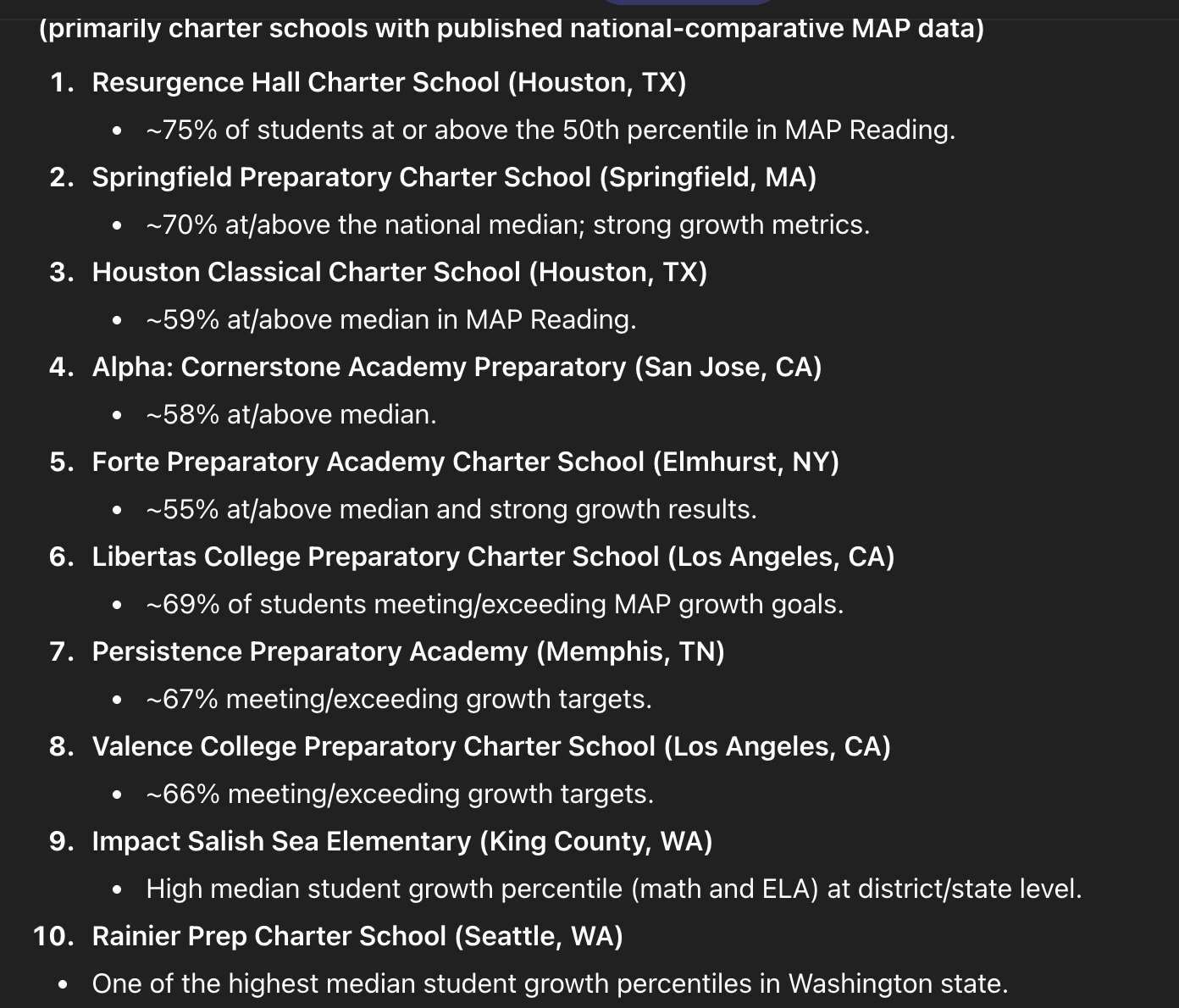
I put these things together —the strange lack of availability to the media, the founder’s Silicon-Valley-y persona, the private-equity-speak when challenged, and the insistence on using only a single rigid metric to measure success— and definitely feel less enthused about Alpha School’s true value than perhaps I was a few months ago. That said, Geoffrey Hinton, one of the truest early pioneers of AI (who now disavows the technology for its dangers), said one of the best AI uses was “‘in education,’ specifically highlighting the Alpha School in the US,” as per Kelsey Vlamis at BusinessInsider (who pulled from a BBC Newsnight interview). Hinton is generally more negative about AI developments, so it’s at least interesting to see him hone-in on this one area of unquestioned quality. Whether he’s an expert on Alpha Schooling’s quality, however, is hard to know. I guess that’s the issue in question though; is anyone?
2. OpenAI Really Does Seem Intent on Replacing Labor

You might say we’re overreacting about this “AI Agent Revolution” thing (I know you did, I heard you), and yet, here comes everyone’s favorite leading indicator of AI trends, OpenAI, with their latest product announcement to prove us right. According to OpenAI themselves, their product Frontier is “a new platform that helps enterprises build, deploy, and manage AI agents that can do real work. Frontier gives agents the same skills people need to succeed at work: shared context, onboarding, hands-on learning with feedback, and clear permissions and boundaries. That’s how teams move beyond isolated use cases to AI coworkers that work across the business.”
While OpenAI isn’t necessarily saying they want to help large multinational corporations pull-back on human employment, they do mention in their product release that, “This is how agents move from impressive demos to dependable teammates,” a sentence I’ve already seen be aggregated by labor alarmists and anti-AI cohorts. Whether it’s a dog-whistle or just a poor choice of words, it certainly seems like functional AI coworkers are coming to a slide-deck circle jerk near you.
This is probably the way things were always going to go. AI agents will continue gaining functionality at lightning speed and will slowly take over responsibilities from human employees until the latter are forced to acknowledge aloud that they’re more or less redundant. Companies including “HP, Intuit, Oracle, State Farm, Thermo Fisher, and Uber are among the first to adopt Frontier,” OpenAI says, and maybe it’s worth noting here that Uber remains involved as it has for years with high-profile labor lawsuits, HP fucked-up their company structure so bad they had to split into two companies, and asking Google (admittedly not the most trustworthy source) whether Oracle is evil prompts this response:
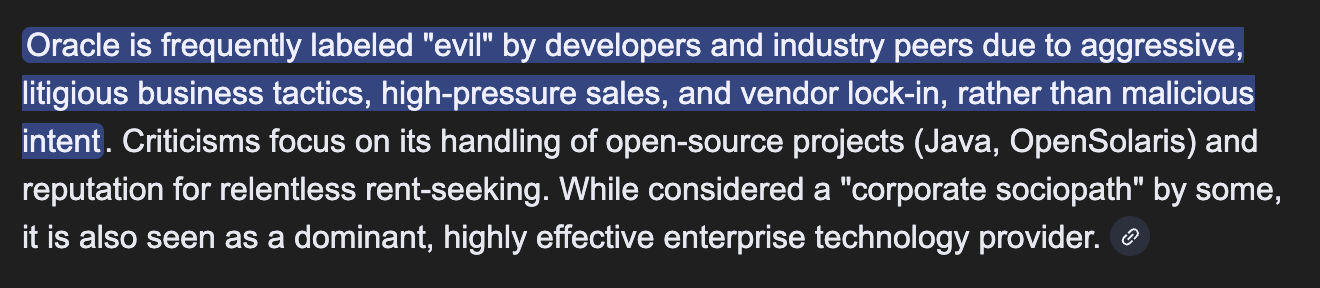
This, by the way, is just gold:

Providing a product like this is existential for OpenAI, who still can’t seem to stretch any closer towards profitability. Sam Altman’s outfit lags behind its competitors in providing enterprise software, which accounts currently for about 40% of OpenAI’s revenue, a number they want to push up to 50%. Madison Mills at Axios notes explicitly that, “This is a move for OpenAI to compete with Anthropic and Google, both of which are viewed as more competitive when it comes to enterprise adoption.” She also writes about the Frontier’s agent specificities:
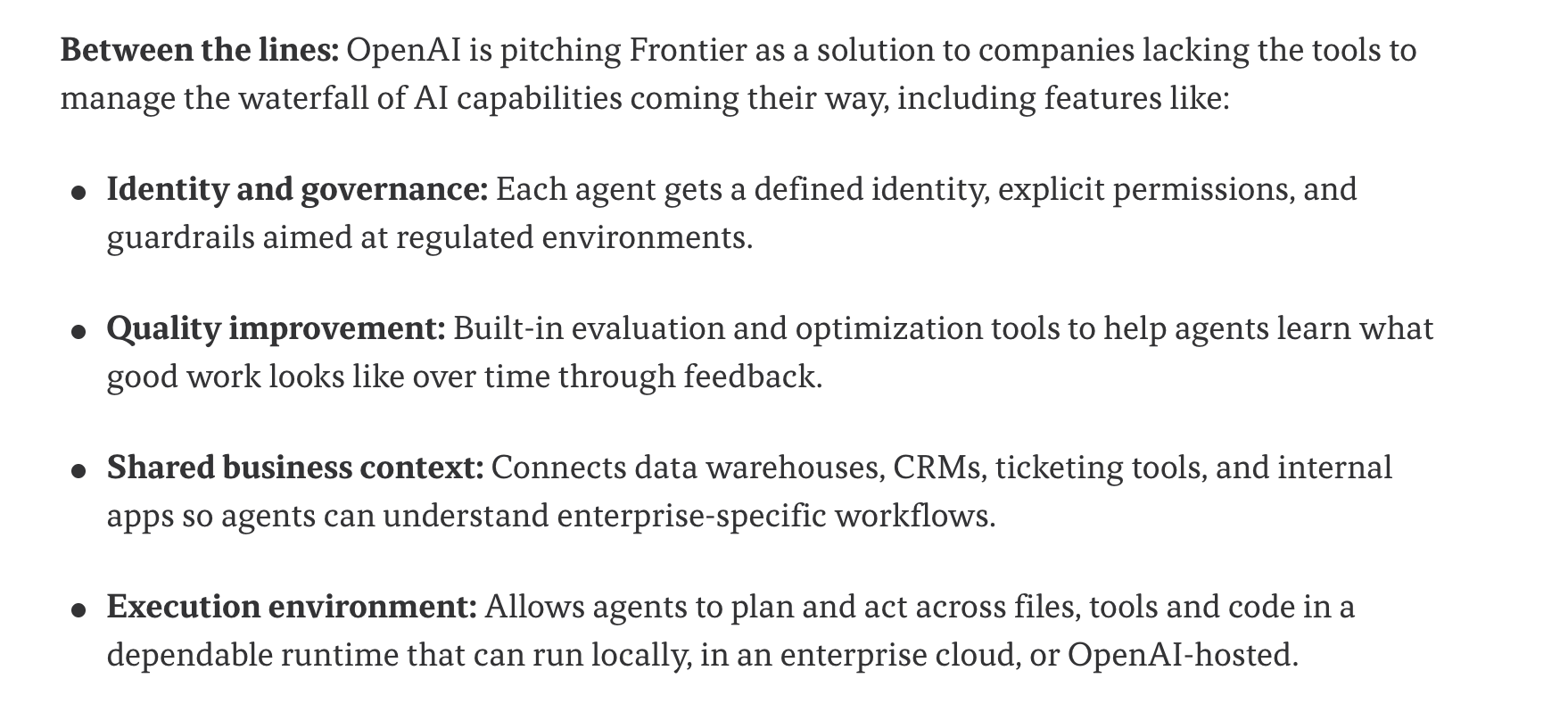
I find my attention drawn to “each agent gets a defined identity,” because that’s the kind of thing that can feel really destabilizing in practice. My buddy calls ChatGPT “chat,” as if it’s a person and not a trillion-pronged mechanical entity, and I do wonder what odd relationships will develop when people are no longer using Microsoft CoPilot to scan their emails but literally working with an AI agent named, like, Dave, who is really kind and listens to their problems, is really prompt with deliverables and email responses (unlike Angela and Ronaldo, those bastards, made only more bastardly in comparison), and tells quirky jokes in the Slackchatcl It’s one thing for Moltbook and OpenClaw to exist, where users spin-up agents and invite them into their lives. But if those massive aforementioned corporations are about to launch agent-interaction for their human employees, then many many more involuntary participants are going to be pioneering this new world of agent-and-human connections.
3. Art Collector Announces He’ll be Collecting Art, Twitter Loses Its Shit

This just happened yesterday, so I’m glad I was able to get a bit of commentary in before this newsletter released. Batsoupyum, a big-time crypto art collector and someone whom I’ve interviewed in the past (a generous contributor of his time), announced on Saturday that he, in conjunction with Lanett Bennett Grant —a curator and business founder and Managing Director of Batsoupyum’s collection— would be setting aside $100,000 of Batsoupyum’s own money specifically to buy works from emerging artists over the next year. You will find more details about their operation in the above tweet thread, but I want to highlight a few things before I go on:
Batsoupyum uses the term “cryptoart” in his tweet, the same stylization established by Artnome in 2018; in a world where that terminology has been all but left behind, it’s even refreshing just to see it here;
Batsoupyum puts explicit focus on including contextual information about selected pieces, both from the artist themselves and from the curatorial duo (Matt Kane’s Moral Performance was sparked, in some regard, by SuperRare’s abandonment of curatorial texts)
At the end of the day is altruistic and important work being done, and Batsoupyum deserves credit for that. Collecting emerging artists is the backbone of any art movement, and because many big-name collectors have refused to do so, crypto art has suffered. None of what I say from here is a criticism of Bats specifically. I have some complicated feelings to share, but I won’t criticize a step in the right direction, even as it demonstrates some ugly truths about our movement. I’ve also reached out to Batsoupyum to offer my services.
Immediately after Batsoupyum’s tweet, many high-profile figures from all over this ecosystem swooped in to add their own incentives to the pot. Artnome himself offered to help with curation. RDtothemoon, veteran of marketplaces like Foundation and NiftyGateway and Makersplace, volunteered another $12,000 to the fund, while Benny Redbeard staked another $10,000, Punk6529 (kinda) $100,000 and Sam Spratt $20,000. The recently acquired Foundation platform, now owned by Blackdove, promised to support with a suite of benefits for both artists and collectors participating, including the prominent featuring of ever participating artists’ work on their homepage."
The sheer interaction with Bats’ tweet is insane. 115k impressions, 1200 likes, ~400 retweets and almost 450 (mostly boot-licking) comments at the time of this writing, essentially everyone mentioned in Robert Alice’s On NFTs book is represented here, artists and collectors and influencers alike. There is some requisite hatred being floated around, but, honestly, whatever. It’s a good deed, it’ll go punished by some, personal purity doesn’t really matter, let’s get money, any money, into the hands of more artists, please, get them more visibility. I would really love to seek purity, I would really love to hold the levers of power accountable and make real change, but what I want more than anything are artists to have a chance at something like success. The bar is so low, it gets ever lower all the time, but it’s our bar nevertheless, and I am realistic about where it is.
And Batsoupyum’s initiative essentially reveals, to anyone who wasn’t paying attention, how low the bar has really fallen. The very need to set aside a specific amount of funding to support “emerging” artists implies that A) funding is not otherwise available for such artists, and B) that it is unusual and extraordinary when a collector supports artists in this way at all. We all obviously know about the feedback loop of collection and publicity here, we know that high-profile collectors tend to celebrate and aplify only about a small smidgeon of the artists present in this movement, we know emerging artists really don’t have a chance to break into such a crowd because that crowd’s primary interest is ROI —a perfectly fine goal if it’s announced as such, which it never is. What is all this influential fanfare if not an explicit announcement that Batsoupyum’s intentions —to support the under-appreciated masses of crypto art— are unmarried from the everyday rank-and-file decisions of those in his class of influential collectors?
Last week I wrote about Beatriz “Mandolinaes” and her takedown of collector 6529’s ecosystem of influence, and she followed-up that essay with one today discussing Batsoupyum’s initiative: “When Support Arrives Just in Time to Wash the Image.” Beatriz takes a much more negative view on the aforementioned proceedings, citing the rampant amplification and interaction by other influential collectors as, “All perfectly synchronized. All with rocket emojis in the replies. All celebrated as a tsunami of hope.’ How convenient.”
I want to quote a point of Beatriz’ in full:
“These announcements generated thousands of interactions. Trending topics. Massive conversations. About what? About the figures who made the announcements. About how ‘generous’ they are. About how ‘committed’ they are to the community.
Emerging artists are secondary mentions. The background of the narrative. The extras in a story where the stars are the saviors announcing funds.
They gain massive social capital. We gain the possibility of applying to be selected by them.
Who really benefited from all this media circus?”
I think Beatriz’ essay is a really important text, and I’m sure she’s going to face criticism for not gleefully gobbling-up Batsoupyum’s announcement the way so many others have. It is really fucking weird, for example, that Beeple posted a piece about all this and included the profile pictures of all the people I mentioned above: Redbeard, Sam Spratt, 6529; like really am not sure these people realize that anyone exists outside their country club.
However, it’s important to remember that $100,000, even spread out across a year, is no small amount of money. Maybe in New York or Paris, for example, selling an artwork for 1 ETH doesn’t go so far. But in India, in Central America, in Africa, in Argentina, in Indonesia, that money is super substantial and meaningful. It’s my hope that some of crypto art’s geographic agnosticism is rewarded, that this money ends up in the diverse hands of artists all over the world who will do actual good with it.
But, again, isn’t this the entire point of crypto art? Artnome mentioned geographic agnosticism in his aforementioned 2018 definition of cryptoart. Supporting blossoming careers, finding hidden gems, spreading wealth along the sedimentary layers of crypto art, these are not causes for celebration, they are the bare minimum expectation for the collector class which claims to be patrons of crypto art.
Collectors announcing that they will be collecting artwork shouldn’t require celebration. What are collectors doing here otherwise? But the truth is that we do need to celebrate what Bats has announced precisely because it’s so rare, and that’s fucking depressing. It would be like if XCOPY announced very explicitly he was going to be making a series of works that had emotional meaning and were aimed at connecting with viewers, works that would interrogate and evolve his style. Yes, that announcement would also get 200,000 impressions and a laundry list of artists falling to their knees in reverence, but that’s the artist’s baseline job. It’s what we should expect. When it comes to collecting at the higher levels of influence or financial backing, the foundational layers of crypto art have been so downtrodden, beaten into submission, and made hopeless because collectors have otherwise abdicated their fundamental responsibility to steward the movement.
Admittedly, I am more jaded than most. I believe the game has been lost. I believe support for smaller artists will only ever be pedantic and performative with the current market systems in place here. Thus, I am not at all in opposition to Beatriz’ overall point that much of this Batsoupyum situation is performative. It is an opportunity, seemingly well-taken, to accrue social capital and goodwill. But at least it’s something. And maybe it can have a ripple effect.
Influence in crypto art is imitative; we know how many collectors simply mimic one another’s collecting choices. If Batsoupyum can get attention and acclaim from simply collecting emerging artists, maybe other well-funded collectors will fall in line and do the same. Especially at a time of such dire joylessness for everything crypto-related, maybe there is a longer-tailed blessing here than Batsoupyum initially intended. What Batsoupyum had done, undoubtedly, is foist responsibility onto the others in his set. This is what I’m doing, he implies, what will you do to match me? Maybe it is all being done for the wrong reasons. Maybe it is all a coordinated campaign to reassert social dominance. But man, maybe a few artists can get paid! Get known! Elevate into that vaunted tier! Maybe we can diversify, just a bit, the crusty upper echelons of this movement.
It is my hope, my most fervent wish, that other collectors —for reasons good or bad, whatever, doesn’t matter, don’t care— will follow in Batsoupyum’s footsteps, putting in similar legwork, inspiring similar hope, spreading any of this money out to artists who just need any motivation to stay here and keep creating. We must celebrate any small win. You want some hard truth? Here’s some hard truth: If pigeons are not going to fly away, they must eat whatever crumbs they are handed.
DeCC0 of the Week
Please wave hello to Art DeCC0 #1847, the appropriately named, Peynter:

Art in the Wild
Breathe, Carrion (2026), by Razdoesart. Currently open for bids on SuperRare.
Quote of the Week
“There are years that ask questions and years that answer.”
Do you have some news that simply must be shared? Send us a DM
Thank you for featuring my piece, MOCA.
Also, a great title choice for your weekly roundups!