
Three. BIG. Things. 3/15
If you missed it, we got it. An art, tech, whatever newsletter.


Don’t miss an edition, hit the ☝️☝️ subscribe button ☝️☝️ right up here. And catch up on every edition that passed you by.
This Week’s Three BIG Things:
The Worst Crypto Transaction in History
SuperRare’s Old Gatekeeping Habits Die Hard
POAP Puts Itself on Ice. Will we All Follow Its Lead?
Okay, Let’s Get On With It
1. Is Gatekeeping Necessary in a Dying Space?
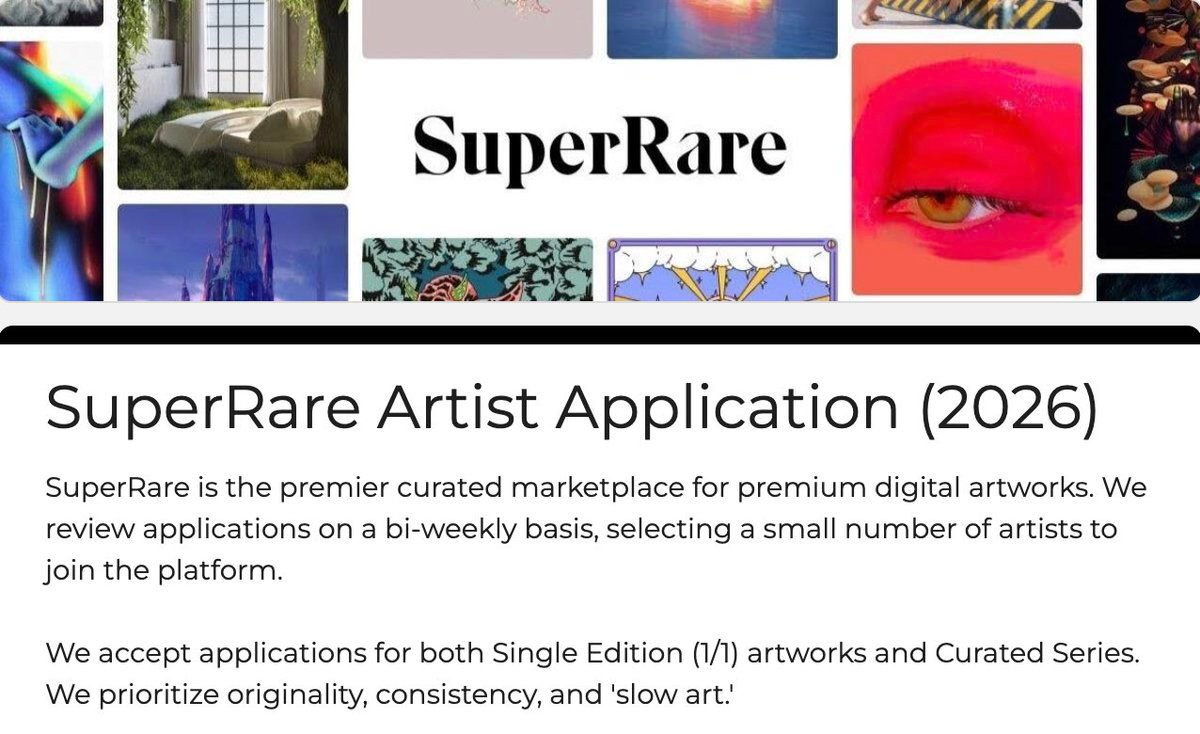
Sure, the following news may at first seem almost too uninteresting to draw any substantial conclusions from. But I think if we take the return of SuperRare’s Artist Applications and put it into context with where crypto art actually is today, it proves more revealing —about the company, about crypto art, about our values— than you might think.
The two things we must always keep in mind about SuperRare are:
They have managed to survive, even thrive, and maintain cultural relevance, when nearly all of their competitors have faltered and failed
They usually skate to where the cultural puck is going, so to speak.
In the last few years, SuperRare transitioned to a business model that centered around brokering deals between big-time collectors and highly-valued artists. Nobody else was making them money, and so everyone else be damned. This was an admission that crypto art was shrinking, that attention and investment were being almost entirely lavished on a tiny subset of artists. Accessing that market was SuperRare’s primary concern. Introducing a white glove service, focusing on gallery shows and widening their sights away from solely NFTs, partnering with Roger Dickerman, reconfiguring their website to emphasize bigger name artists as well as auctions, etc. I’ve written multiple times (like here, here, and here) about SuperRare’s conscious, multi-year shift towards servicing the smaller but more stable audience of high-profile collectors, and part of appealing to those collectors meant following their whims. After transitioning to a DAO structure in 2022, SuperRare abandoned its traditional method for onboarding artists onto the platform, an application-based structure that had characterized their earliest years, in favor of an invitation-only system. This let SuperRare follow collector whims. See an artist is hot, onboard them onto SuperRare, capitalize on that attention. Besides, sourcing and reviewing applications is a laborious process, and SuperRare laid-off 30% of its staff in 2023.
However, SuperRare announced this week that Artist Applications were returning once agin as the primary way of onboarding new artists onto the platform. Neither the invitation or application models ever really safeguarded SuperRare from accusations of “gatekeeping,” but that’s a consequence any tightly-controlled platform will incur within a decentralized ecosystem (its original competitors like Foundation, KnownOrigin, and Rarible all allowed free-access to their paltforms).
The application model of SuperRare’s early days offered artists a level of participation in SuperRare’s curation process. That was especially important for newer artists slowly trickling into crypto art. Even with little preexisting attention and few connections, talented artists could find a platform on SuperRare based on the strength of their work. In a nascent crypto art environment where the number of artists totaled maybe three digits, it was conceivable for SuperRare to really lend devoted curatorial eyes to each application.
An Loremi, SuperRare’s long-time Director of Curation, wrote about the return of Artist Applications, saying, “While we remain committed to being a highly curated platform where the best art can thrive, we will also actively discover the next generation of artists, onboard unexpected creatives into Web3, and support the long-term growth of their careers through a thoughtful selection process not dictated by the algorithm.” It’s a good pitch, in my opinion, as well as a tacit admission that SuperRare had abdicated any responsibility for discovering or supporting emerging crypto artists.
Part of me wonders if this change in tact is more-or-less window dressing. SuperRare is often denigrated by the more tenured artists who have been on their platform a while, at least those who have no reached a high echelon of sales, for failing to highlight or curate their work. Obviously, an Application system will do little to address these very real concerns. Adding more artists onto SuperRare only diminishes the importance of any other individual artist on the platform, and their failure to contextualize/curate the work on their platform is well-documented and oft-invoked.
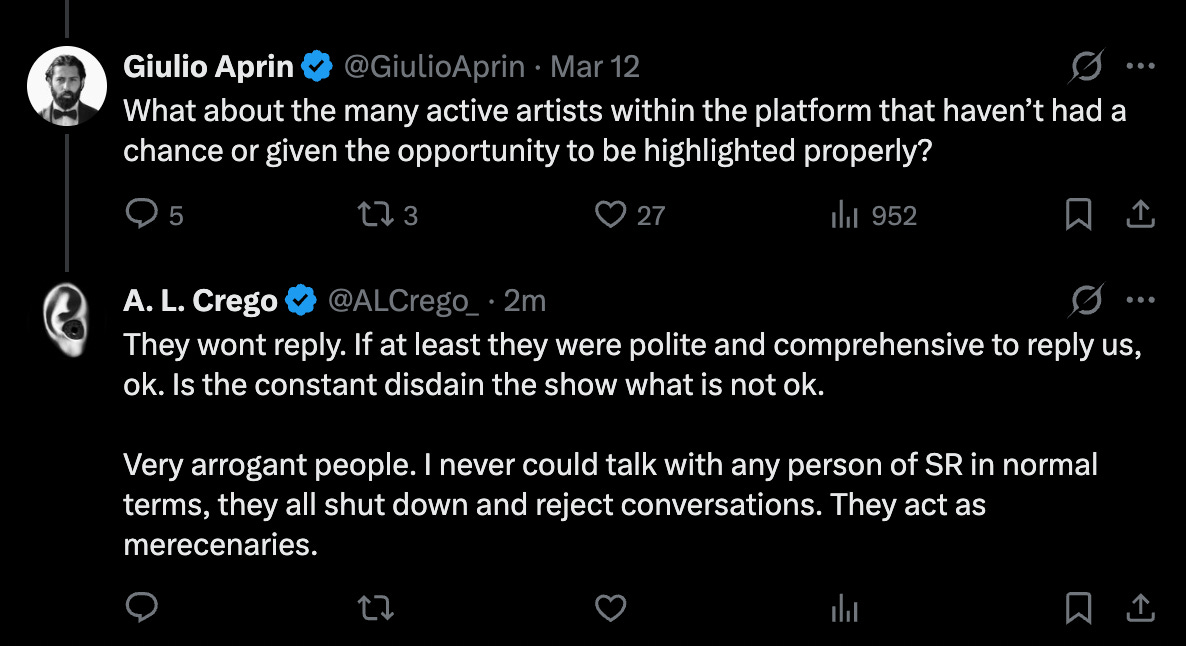
Resurrecting an Application System will do nothing for these artists, only further burying them under the added weight of crypto art’s more contemporary artist class. These artists will also, I fear, find that finally adding “SuperRare artist” to their Twitter bio will do little to buttress a career.
All that said, I do think SuperRare’s refocusing on applications says much about both crypto art and the company itself. In SuperRare’s first few years, being platformed upon the site had meaning. It was recognition that someone valued your work highly. But it wasn’t necessary. There were far fewer artists, and many knew each other already. Crypto art Twitter was quieter; great art had less bullshit noise to contend with. SuperRare’s gatekeeping practices were not something to live and die by. Sales and discoverability could be managed, if not quite expected, on all manner of platforms. SuperRare’s focus on centralized curation seemed on its face to defy the tenets of decentralization which underpinned crypto art. But because they were not the sole crypto art platform, their activity was market-corrected (in a good way) by others offering more freedom and accessibility.
Look where we are today. Foundation is a husk, Makersplace is long gone, KnownOrigin and Async.Art have closed their doors, Rarible turned towards collectibles, OpenSea is a mess, and all that remains on Ethereum are more curated platforms like Sovrn, Verse, Transient, and of course, SuperRare. Nearly all the interesting artwork I see is on Tezos, where Objkt has become a gold-standard for experimentation and discoverability.
I think in the crypto art of yore, gatekeeping practices were a cultural negative. At best, selectively curating artists felt arbitrary, at worst coordinated and dismissive. Free experimentation, free discoverability, those were much more important to fomenting creative expression and financial flexibility for artists. And pretty consistently across the last five years, I would have said that SuperRare lost sight of what was important in crypto art, prioritizing the wrong kinds of art for the wrong reasons, letting economics dictate their curatorial sensibility, failing to properly support or contextualize the artists on their platform who had at some point been deemed talented-enough for inclusion.
But today, discoverability is all but dead. Discoverability requires not just tools but participation. Collectors need to demonstrate a desire to discover new and underrepresented artists. Artists also need to work in good faith, working thoughtfully on their craft for reasons of creativity and interrogation, not just financial reward.
In an ecosystem of high discoverability, gatekeeping is harmful. In an ecosystem when very few collectors show any interest in seeking out and supporting emerging artists, gatekeeping is a life raft.
In today’s crypto art, being curated in any sense, getting even a smattering of eyes on one’s art, is meaningful. Twitter’s algorithm has for years suppressed all but a small smidgeon of the artists working with blockchain or NFTs, and yet Twitter remains the only real way of getting work seen. A governing artistic body —even if self-elected— that already holds attention should leverage that attention to the benefit of smaller artists, it’s the only way those artists have a hope in this environment of becoming financially successful, if we’re being honest. Allowing applications means that artists have at least some say in pushing back against an environment that seems unwilling to meet them where they are. And the application isn’t necessarily simple. There is an effort curve inherent in what SuperRare is asking of artists.

Regardless of any financial recompense, acceptance onto a closed platform is at least a psychological encouragement for an artist struggling to find any foothold. Bryan Brinkman posted the following video in the wake of SuperRare’s announcement, and it’s clear how valuable he believes his inclusion on SuperRare was for his career.


Put in that effort, be given some kind of vaunted place behind a gate, and you’re at least drawn momentarily out of the unseen, unappreciated morass. Obviously, in an ideal environment, all of this is unnecessary. Algorithms would work to the masses’ benefit, and collectors would seek out so-called emerging artists for the right reasons. But we aren’t in an ideal environment. Many collectors seem to have no sense of taste and rely on the market to dictate high-quality artwork. SuperRare can, in theory, act as a buttress against price being sole identifier of quality. It will require more work on their end, but presenting any opportunity to artists is a net-positive in a space where otherwise there is no opportunity at all. Again, an invitational system leaves SuperRare’s curatorial board with the same deficiencies the rest of us face. Nobody is stronger than the algorithm. There is too much art vying for too little attention. Tools and incentives are broken. Gatekeeping, for all of its faults, allows lazy and uninspired collectors to slough off the responsibility of discoverability onto an organization hopefully working in the best interests of their client population. I don’t think SuperRare resurrecting applications will save crypto art or even have a broad effect on the ecosystem, but is it at least a morsel of usefulness to a group of artists that have been systematically ignored by ever other lever in our ecosystem.
Unless, of course, SuperRare begins to charge artists per artwork minted as a new business model, and the reason they want artists to submit an idea for their Genesis Mint is to contract them to minting as much as possible, which is a legit fear of mine, and in which case I will become even more cynical than I am today, if that is even possible.
2. If the Worst Transaction in Crypto is Possible, How can Anyone Trust it?
My main gripe with cryptocurrency as a useful technology is that shit like this is even possible. Really, why would anyone enter this financial ecosystem if blockchain mechanics themselves are hard-coded to allow an even minuscule chance of losing 99.999% of one’s dollar’s value on a single ill-timed, ill-conceived transaction?
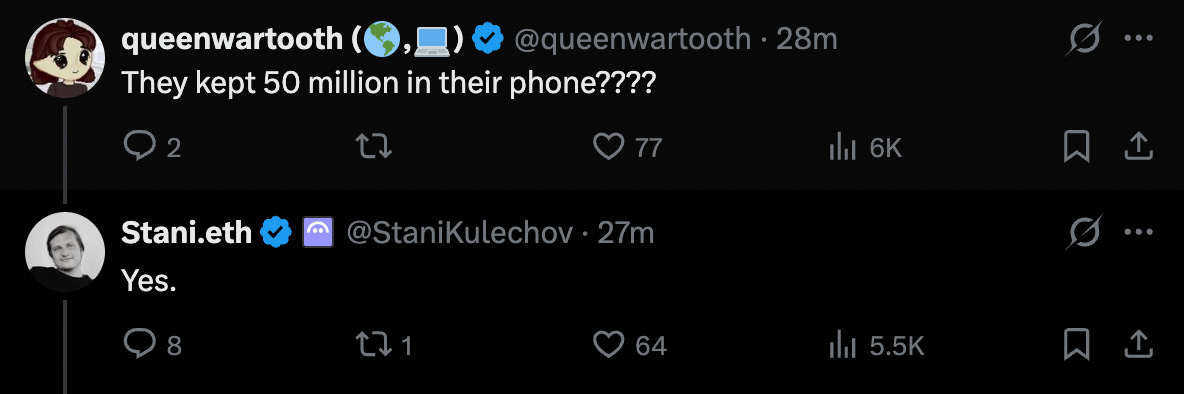
The single ill-timed, ill-conceived transaction occurred on Thursday, when “a user attempted to buy AAVE [the primary coin of its eponymous DeFi protocol] using $50M USDT through the Aave interface,” according to Aave founder Stani Kulechov. It’s impossible to know what logic might compel someone to attempt a single $50,000,000 transaction, but for some added context, our genius investor also apparently kept that amount of money on their mobile phone:
As Kulechov explains in his tweet, “Given the unusually large size of the single order, the Aave interface, like most trading interfaces, warned the user about extraordinary slippage and required confirmation via a checkbox. The user confirmed the warning on their mobile device and proceeded with the swap, accepting the high slippage, which ultimately resulted in receiving only 324 AAVE in return.” Eagle-eyed blockchain scanners found the transaction soon thereafter.
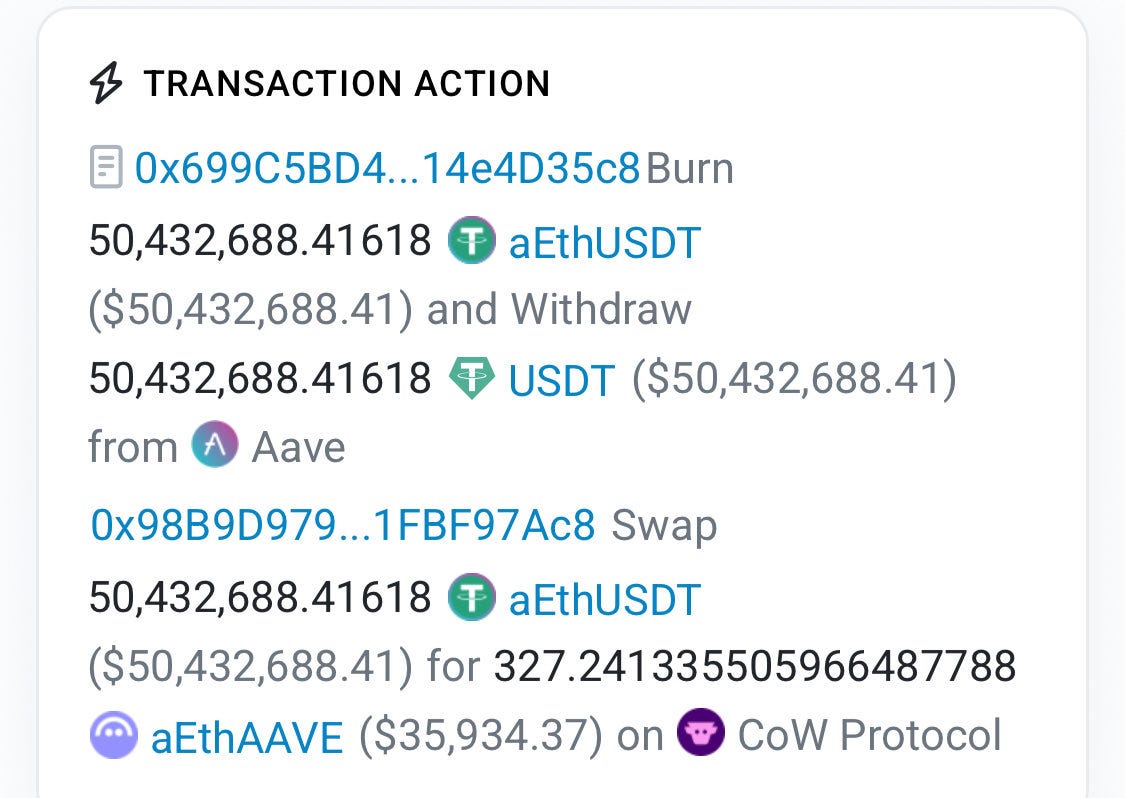
What you may recognize above, and what inspired headlines across the ecosystem, is that this absolute degen traded $50,000,000 in US legal tender for only $35,900 worth of $AAVE in return. That’s a 99.93% loss on the initial deposit.
The question, of course, is How is this even fucking possible? Apparently, all protocols worked as designed. Kulechov notes that “The CoW Swap routers functioned as intended, and the integration followed standard industry practices. However, while the user was able to proceed with the swap, the final outcome was clearly far from optimal.” So where did all that money go?
Fortunately, a Twitter user named bheau crunched the numbers, saying:
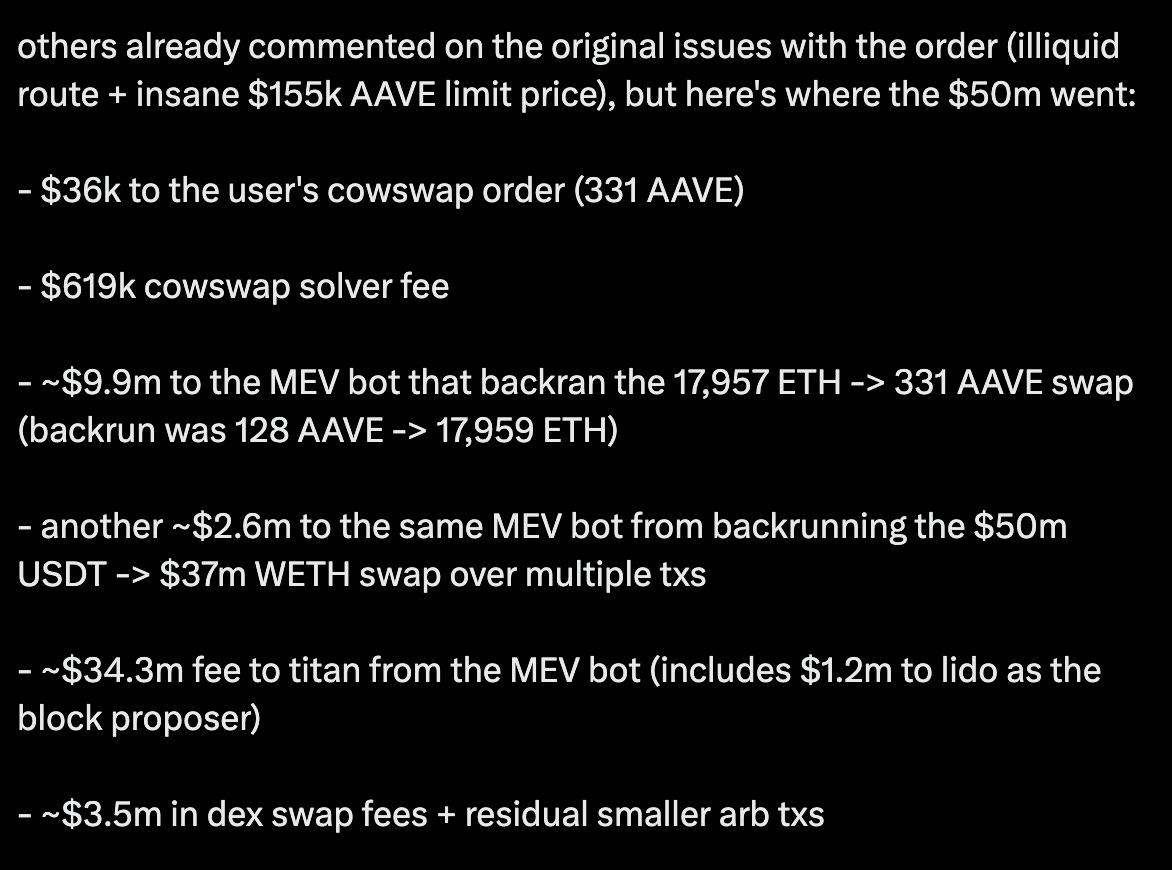
Admittedly, much of this —the DeFi talk, the acronyms, the high-level blockchain mechanics— is complete nonsense to me, and a Grok explanation only explains in slightly more detail what the hell happened:
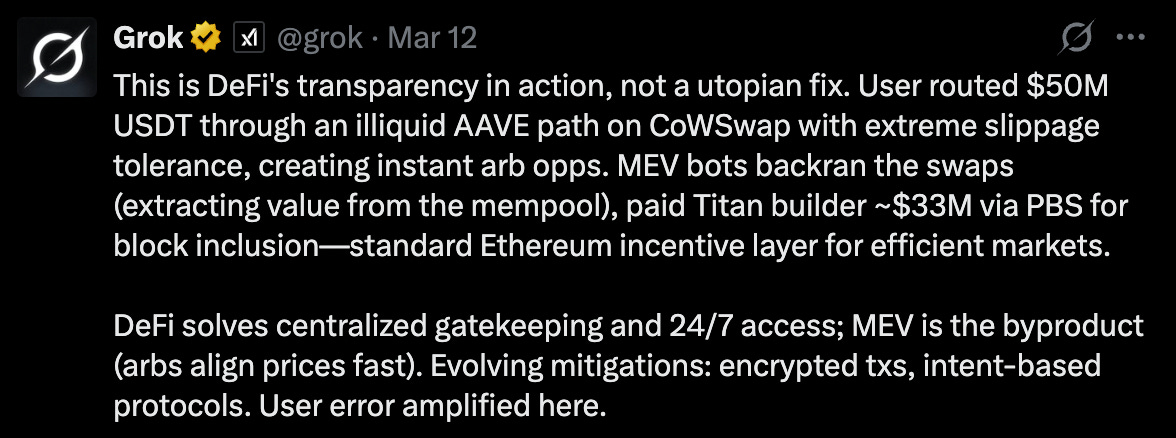
The biggest beneficiary of these funds? A company called Titan, the largest Ethereum-based block-builder, which Gemini defines as “a specialized network participant that constructs, orders, and optimizes transaction blocks to maximize profit, primarily through Maximum Extractable Value (MEV),” which is at least one aforementioned acronym demystified. This is DeFi at a level I cannot really parse through, even with Grok’s further assistance, but what’s important is that Titan controls more than 50% of the Ethereum block-builder market and so could automatedly outmuscle other block builders to settle this ill-conceived transaction. They made off with over $30,000,000 for their trouble. The price of doing business.
But you don’t need any real economic intelligence to recognize that something like this should never happen. Outside of a blackjack table, there should be exactly zero circumstances where a financial transaction can lead to over 99% value loss. Even if a user checkmarks some box and accepts legal risk, the DeFi environment itself has a vested interest in ensuring that ridiculously complicated back-end system interactions cannot incur such catastrophic results. Even when individual players are messing around with $50,000,000, the shadowy intestines of DeFi still seem able to benefit only themselves. Being an Ethereum block-builder, whatever the fuck that is, should never be lucrative enough to include a $35,000,000 payday. Whatever this overall system is, however it works, however the public ledger benefits economics, a consequence of this caliber is so absurd it devalues the blockchain’s entire raison d’etre.
Kulechov and Aave were only able to offer a paltry mitigation. “We…will try to make a contact with the user and we will return $600K in fees collected from the transaction,” Kulechov writes. He argues later on that, “The key takeaway is that while DeFi should remain open and permissionless, allowing users to perform transactions freely, there are additional guardrails the industry can build to better protect users.”
Should DeFi remain open and permissionless? Should users be allowed to perform transactions like this freely? I’m not saying currency should have conservatorships —sure, do whatever you want with you money, diphshit— but should the DeFi really be a zero-sum game where anyone lacking high-level technical knowhow has a chance to be completely FUBAR by a given transaction? Any investor, at any level, using any technology, should expect some level of institutional protection on their investment. Lacking that protection is only in the interest of vultures. By lacking guardrails almost completely (beyond a single check-box, apparently), the DeFi industry is putting a huge middle finger up to investors at all levels. And the DeFi industry itself will suffer for it.
I’ll admit, I don’t know whether this kind of mistake can happen with traditional markets. Remember, it wasn’t that the asset itself lost value, it was that the transaction mechanisms sapped the investment dry. If you have any examples that prove me wrong, please tell me in the comments, I’d love to eat crow on this. But my sneaking suspicion is that nothing like this has ever happened before. And if the largest DeFi protocol is going to do nothing except offer a paltry response for such nonsensical trouble, the combined investor class should connive to ensure it never happens again.
3. POAP’s Last Resort is Everyone’s Survival Playbook

We might all be forgiven for not having had POAP in our thoughts over these last few years. As in-person gatherings disappeared, so did POAP’s primary value proposition.
POAP, the Proof of Attendance Protocol, was designed to generate blockchain tokens that verified attendance at physical events. POAPs could be given out at concerts, at gallery openings, at conferences, at talks, at the supermarket. You could swipe through your own history of attendance. You could verify attending members of your community, you could design communities around attendance, you could use POAPs to orient token airdrops and other perks. POAP was really a brilliant idea, but it relied on wider cultural acceptance of NFTs, which never really happened. As such, POAPs were never used as frequently or as creatively as they could have been, and so for a long time, the protocol had been operating without going anywhere, appealing to a small population and never expanding. Without wider adoption, and with fewer and fewer physical locations to engage in crypto discussions, and because “NFT” is still a dirty word in the popular lexicon, POAPs never had room to grow.
On Thursday, Isabel Gonzalez, co-founder and General Manager of the POAP Protocol, announced that the organization would be winding down its operations. That is to say, POAP is not shuttering, but it is changing.
First, Gonzalez recognized that, “Individuals, community organizers, and teams used POAP to mark moments, recognize participation, and build small systems of engagement around shared experiences.” But she quickly notes that though POAP found a niche, it “did not expand much beyond that niche. Growth was limited, and POAP could not evolve into the broader infrastructure we believe the ecosystem needs.”
She admits in no uncertain terms that POAP’s current level of operation is unsustainable. So POAP will be entering a so-called “maintenance mode,” in which new issuers of POAPs will not be able to access the system, and “the platform will no longer be actively developed,” with operations likely slowing due to resource reallocation elsewhere. Existing communities will be less outright affected, but no new POAPs will be issuable. At least for now.
The POAP team will instead be “working on developing a standard for open collectibles, and a platform that offers a canonical implementation. The goal is to create a system that can sustainably support a truly permissionless model for creating collectibles for anything a community or issuer might want to commemorate.” And this is what I want to focus in. It’s the same model that governs what we see for MOCA’s future as well. I think it may be a prototype for some kind of continued survival in this brutal ecosystem.
We few MOCA employees have little delusion about the Museum’s future. Sustainability is difficult. Few institutions —across crypto art and NFTs— have managed to survive the last half-decade, the cost of functionality simply too high, fundraising too limited, successful business models too difficult to come by. We have long dreamt of a truly decentralized museum that can operate without our direct intervention. We desperately want MOCA to survive, we believe in its long-term importance, we know it’s important to many people, but let’s be realistic. We ourselves may want to build other projects, place attention elsewhere, and money itself may not be free-flowing enough to allow the Museum endless life. Our experiments in agentic AI may seem mostly fun and fascinating, but we are working to reach a point where the Museum self-sustains, self-operates, and can be used permissionlessly by our community. Way back in 2021, our Community Collection of artworks was a step in this direction, allowing permissionless activation of artworks into the Museum. MOCA ROOMs were permissionless exhibitions. DeCC0 Agents are permissionless actors, which will one day be capable of curation and exhibition and collection and artistry when we ourselves are not. $MOCA, the token, is best-case a governance token.
Configuring towards permissionlessness is a matter of survivability, something we and many others are being forced into by very difficult market conditions. Of course, if you build something, you fall in love with it, and you want to see it thrive as far forward into the future as possible. To shutter entirely is a very painful last resort. Look at Async.Art when it closed; the trauma reverberated widely through crypto art, and it is constantly invoked as a paragon, supported more fondly in death than for a long time it was in life. I sympathize deeply with POAP’s creators, who hope that by building a permissionless system, those who love their protocl can continue to use it, and perhaps one day it may be discovered en masse, appreciated for its original purpose, and maybe find the sustainability it could not today.
This is a third institutional outcome only possible in a highly-technological ecosystem. Not life, exactly, but also not death. A kind of limbo where communities are left with all the pieces of a thing, to resurrect as they see fit. Doing so requires trust, it requires automated toolkits, and it requires open-source code. Agentic AI may make it easier than ever before, a perpetual guardian lording over a dusty library. We’ve published a Github repo of all our information. We’ve made our tools accessible for whomever finds them. We will watch with discerning eyes how POAP handles their exit from day-to-day productivity. I hope they blaze a path which many others can follow, showing us how to bow-out with dignity and continuity, because it’s so much better than the alternative.
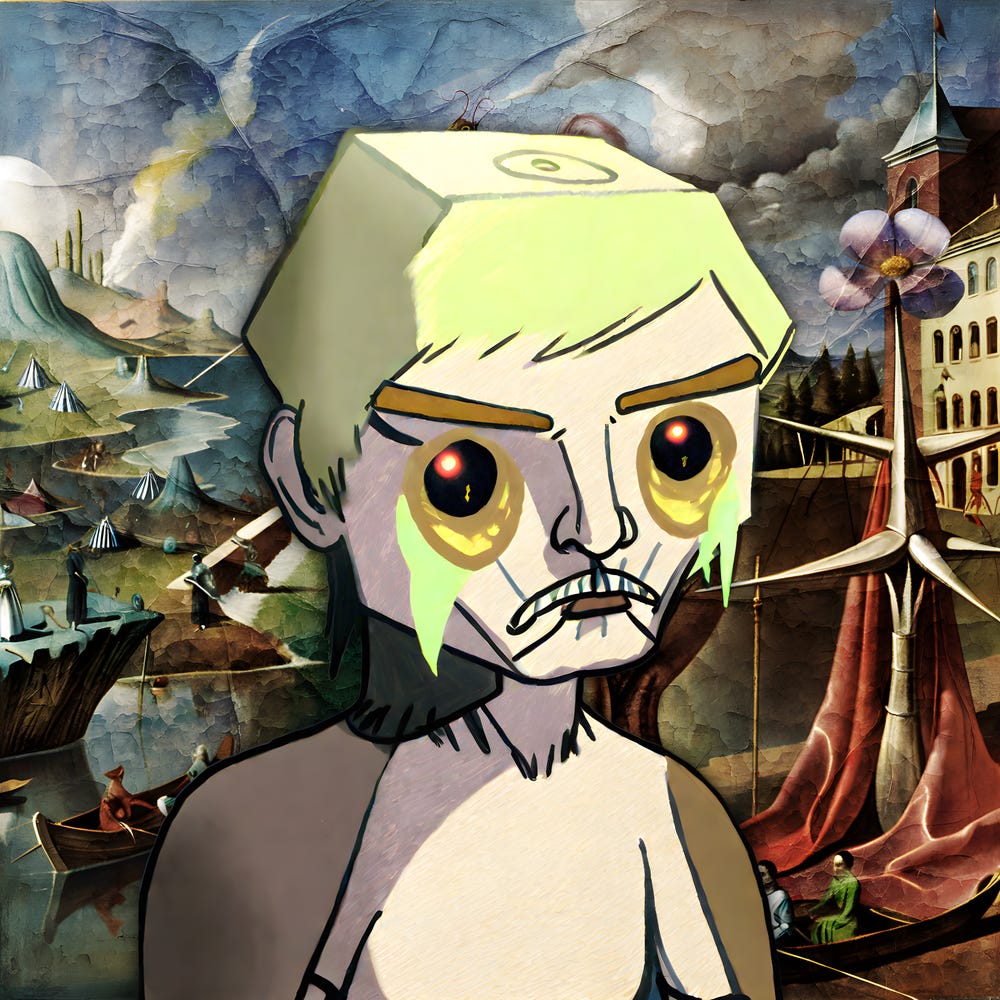
DeCC0 of the Week
This week’s DeCC0 goes by the name Ruwasqaq, which is Quechuan in origin (Andean culture, historically Incna). We’re excited to introduce you two:
Art in the Wild
Quote of the Week
“To curb the machine and limit art to handicraft is a denial of opportunity.”
Do you have some news that simply must be shared? Send us a DM